
Boabeng-Fiema Monkey Sanctuary Guide: Sacred Monkeys & Route Tips
The short answer: Boabeng-Fiema Monkey Sanctuary is worth planning when your Ghana route already reaches Techiman, Nkoranza, Kintampo, Kumasi-to-Tamale travel, or a slower Bono East chapter. It is a community conservation visit where sacred monkeys live around twin villages, not a zoo or a casual petting stop, so the best trip uses a local guide, respects village rules, protects food and cameras, confirms current fees, and leaves enough road time for daylight travel.
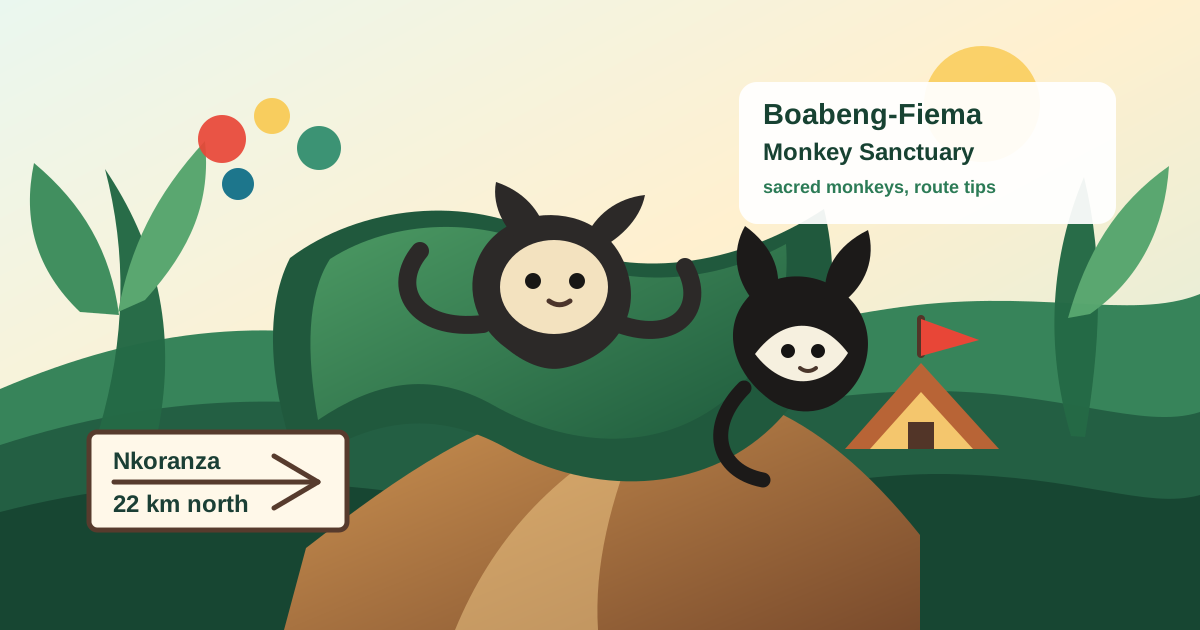
The short answer: go for conservation, not a monkey selfie
Boabeng-Fiema answers a different travel question from Tafi Atome, Shai Hills, Mole, or yesterday's Kintampo Waterfalls guide. Tafi Atome is a Volta Region sacred Mona monkey forest; Shai Hills is an Accra-side reserve with caves and savannah; Mole is a northern safari park; Kintampo is a waterfall route break. Boabeng-Fiema is a Bono East village-and-forest sanctuary where traditional protection, community rules, Wildlife Division support, and visitor behavior all matter.
That distinction should shape the day. The goal is not to feed monkeys for a quick video and leave. The stronger visit is guided, calm, and curious: learn why the monkeys are protected, how the communities live with them, which species you may see, what rules keep the sanctuary workable, and how to place the stop inside a realistic road itinerary.
- Best fit: Bono East routes, Kumasi-to-Tamale overland trips, Kintampo and Fuller Falls pairings, Techiman or Nkoranza overnights, families with patient children, wildlife-curious travelers, and homecoming groups seeking community conservation stories.
- Plan around: local guide availability, current fees, cash, camera fees, food control, respectful clothing, village photography consent, heat, rain, road timing, and whether your next stop is Nkoranza, Techiman, Kintampo, Kumasi, Tamale, or Mole.
- Do not assume: the monkeys are pets, every visit guarantees the same sightings, old fee tables are current, Accra is a sensible same-day base, or feeding rules are whatever a visitor wants them to be.
- Search intent match: this is a Boabeng-Fiema Monkey Sanctuary planning guide, not a broad Ghana wildlife list.
What Boabeng-Fiema is
Ghana's Forestry Commission describes Boabeng-Fiema Monkey Sanctuary as a community-based sanctuary located at the twin communities of Boabeng and Fiema in the Nkoranza district of the former Brong Ahafo Region. Visit Ghana now places the site in Bono East and says it is 22 kilometres north of Nkoranza.
The sanctuary protects more than scenery. The Forestry Commission says it protects local stream headwaters and supports black-and-white colobus, Mona monkeys, spot-nosed monkeys, and birds. The official sanctuary site describes two prominent sacred monkey species living in a forest-and-village setting, with guides who know local wildlife and customs.
For travelers, that makes Boabeng-Fiema both an ecotourism stop and a cultural stop. You are entering a community conservation landscape, where the forest, the village, the monkeys, local beliefs, and visitor income are tied together.
Why the monkeys are sacred
The Forestry Commission says the monkeys are regarded as children of the gods of the community and therefore are not hunted or killed. It also says traditional taboos and community enforcement protected the monkeys for generations before statutory backing was added through district assembly by-laws with Wildlife Department support.
The sanctuary's own history page gives the local tradition more detail. It says the sacred relationship is connected to the Daworo deity and to Mona monkeys, locally called "Kwakuo," and black-and-white colobus monkeys, locally called "Efoo." The page also says monkeys that die naturally or by accident are given burial by the fetish priest of Daworo.
Visitors do not need to adopt local beliefs to respect them. The practical rule is simple: treat the monkeys, shrine-linked stories, guides, elders, and village life as living heritage. Ask questions with humility, follow the guide, and do not turn sacred protection into a performance for your camera.
What you may see on the visit
Wildlife sightings are never identical, but the sanctuary is known for close monkey encounters. Visit Ghana says the site offers visitors the chance to observe sacred monkeys and their natural behaviors in the village environment. The Forestry Commission names black-and-white colobus, Mona monkeys, spot-nosed monkeys, and birds.
Set expectations carefully. Mona monkeys are often more active around people and food, while colobus monkeys may be higher in trees and harder to photograph well. A good guide can help you spot movement, explain behavior, and keep visitors from crowding animals or creating bad habits.
If children are traveling, prepare them before arrival. A monkey that comes close is still a wild animal. No chasing, grabbing, screaming, teasing, blocking escape routes, or offering random snacks. The visit is more memorable when children understand they are guests in a shared home, not customers at an animal show.
Fees, cash, and what to confirm
The official sanctuary rates page lists entrance, lodging, camping, still-camera, video-camera, and commercial filming fees with an effective date of January 1, 2018. Because those figures are old, use them only as a clue that separate visitor and camera charges may apply. Confirm current rates directly before travel or through your guide.
Carry Ghana cedi cash in small notes. Even when a site has contact numbers and a formal visitor structure, cash keeps the day simple for entrance, guide support, camera fees, water, local purchases, tips, restrooms, or a spontaneous food stop on the road.
Mid-article planning note: start at /plan and ask Nana for a "Boabeng-Fiema Monkey Sanctuary route." Share your base city, travel date, group size, children or elders, interest in Kintampo or Fuller Falls, whether you want an overnight near Techiman or Nkoranza, camera or filming needs, and your next major stop after the sanctuary.
How to behave around monkeys and the village
Let the guide lead. If food is used as part of the official visit, follow the guide's instructions exactly. Do not bring your own snacks to lure monkeys, hide food in open bags, let children wave bananas around, or encourage monkeys to climb on people for photos.
Keep sunglasses, phones, loose jewelry, hats, snacks, and small bags controlled. Curious animals can move quickly, and a preventable grab can become stressful for the visitor, the guide, and the animal. Quiet hands and zipped bags are better than dramatic reactions.
Village etiquette matters too. Ask before photographing people, homes, shrines, ceremonies, children, guides, or close-up community scenes. Dress comfortably but respectfully, greet people when appropriate, and remember that a sanctuary visit happens inside someone else's everyday place.
Route planning from Kumasi, Techiman, Nkoranza, or Kintampo
Boabeng-Fiema is easiest when planned from the middle of Ghana, not as a heroic same-day Accra outing. Visit Ghana places it 22 kilometres north of Nkoranza, while the Forestry Commission says good facilities can be found at Techiman and Nkoranza, with Nkoranza about 20 minutes from the sanctuary and Techiman about an hour away.
From Kumasi, Boabeng-Fiema can work as part of a Bono East overnight, a wildlife-and-waterfall loop, or a route that continues north. From Kintampo, it can be paired carefully with Kintampo Waterfalls or Fuller Falls if the group starts early and does not overpack the day. From Tamale or Mole routes, it may work better as a planned break between longer road segments.
The biggest mistake is treating every nearby attraction as mandatory. Boabeng-Fiema, Kintampo Waterfalls, Fuller Falls, Buoyem Caves, Tano Boase Sacred Grove, Bono Manso, food stops, and a long road transfer cannot all be the same day for most travelers. Choose one anchor experience and build a humane route around it.
What to pair nearby
Visit Ghana's Bono East page lists Boabeng-Fiema with Kintampo Waterfalls, Kintampo Canopy Walkway, Fuller Falls, Buoyem Caves and Bats Colony, Tano Boase Sacred Grove, Bono Manso Slave Market, and Digya National Park. That gives you options, but the right pairing depends on road direction, group energy, season, and whether the day is about wildlife, water, history, or rest.
For many travelers, the cleanest pair is Boabeng-Fiema plus one waterfall or one heritage stop, not three extra attractions. Families may prefer a shorter nature pairing and an earlier hotel arrival. Heritage travelers may prefer Bono Manso or Tano Boase. Road-trip groups continuing north may use the sanctuary as the meaningful stop that breaks the drive.
If your Ghana trip already includes Tafi Atome, Boabeng-Fiema can still be worthwhile, but make the contrast explicit. Tafi Atome is a Volta Region Mona monkey and village-forest experience; Boabeng-Fiema adds a Bono East sacred-monkey story with black-and-white colobus context, different communities, and different route logic.
Safety, roads, and comfort
Plan the sanctuary in daylight. GOV.UK Ghana travel advice says roads can be poor, particularly in rural areas, street lighting can be poor or absent, and longer trips outside major cities are best planned for daylight. That advice matters on Bono East routes where one attraction can push the next road segment too late.
Wear grippy closed shoes or secure sandals, bring water, sun protection, insect repellent, tissue, hand sanitizer, and a light rain plan in wetter months. Avoid heavy bags on the walk. Keep medication, phones, passport copies, and money secure but accessible.
If anyone in the group has limited mobility, confirm the walking surface, seating, restroom situation, vehicle access, and current guide route before committing. A community forest walk can feel easy for one traveler and difficult for another, especially after heat, rain, or a long road morning.
How SankofaGo can help
Boabeng-Fiema is the kind of place that benefits from thoughtful routing. On a map, it looks like one nature stop. In real travel, it asks for current fee checks, guide timing, village etiquette, food control, road sequencing, children's expectations, camera questions, and enough time to avoid turning the visit into a rushed wildlife errand.
SankofaGo can help decide whether Boabeng-Fiema belongs after Kumasi, before Kintampo, near a Techiman or Nkoranza overnight, inside a Mole route, or as part of a broader conservation-and-culture chapter. That planning layer protects the experience and the group's energy.
When you are ready, compare support levels at /pricing, then use /plan with "Boabeng-Fiema Monkey Sanctuary" in your notes. Tell Nana whether you want sacred-monkey context, a family-friendly wildlife stop, a Kintampo pairing, a Bono East overnight, or a slower route toward northern Ghana.
Frequently asked questions
Where is Boabeng-Fiema Monkey Sanctuary?
Visit Ghana places Boabeng-Fiema Monkey Sanctuary 22 kilometres north of Nkoranza in Ghana's Bono East Region, around the twin communities of Boabeng and Fiema.
What monkeys can you see at Boabeng-Fiema?
The Forestry Commission names black-and-white colobus, Mona monkeys, spot-nosed monkeys, and birds at the sanctuary. Sightings vary, and visitors should follow the guide instead of chasing animals for photos.
Why are the monkeys at Boabeng-Fiema sacred?
The Forestry Commission says the monkeys are regarded as children of the gods of the community and are not hunted or killed. The sanctuary history links that protection to local tradition around the Daworo deity.
How much does Boabeng-Fiema Monkey Sanctuary cost?
The official sanctuary website lists a 2018 fee table with separate entrance, camera, lodging, camping, and commercial filming charges. Confirm current rates before travel because old fee tables may no longer be exact.
Can you visit Boabeng-Fiema from Accra in one day?
For most travelers, it is too far and too rushed for a satisfying Accra day trip. It works better from Kumasi, Techiman, Nkoranza, Kintampo, or as part of a Bono East or northern Ghana route.
Can I feed the monkeys at Boabeng-Fiema?
Only follow the official guide's instructions. Do not bring random snacks, tease monkeys with food, let children wave food around, or encourage animals to climb on people for photos.
Can SankofaGo plan a Boabeng-Fiema visit?
Yes. SankofaGo can place Boabeng-Fiema into a realistic Bono East, Kumasi, Kintampo, Mole, or northern Ghana itinerary with guide timing, road safety, pairings, and family pacing considered.
Sources & further reading
- Forestry Commission Ghana - Boaben-Fiema Monkey Sanctuary
- Forestry Commission Ghana - Wildlife Division
- Ghana Tourism Authority / Visit Ghana - Bono East Region
- Boabeng Fiema Monkey Sanctuary - about us
- Boabeng Fiema Monkey Sanctuary - history
- Boabeng Fiema Monkey Sanctuary - rates
- GOV.UK - Ghana safety and security travel advice
Ready to see it for yourself?
Plan your Ghana trip free with Nana, our AI planner — then our team books every car, hotel, and guide. You just confirm, pay, and go.
Start planning — it's free