
Ghana Language Guide: Twi, Ga, Ewe, Dagbani & Traveler Greetings
The short answer: English will carry most travelers through Ghana, especially in airports, hotels, restaurants, museums, and major cities, but learning a few local greetings changes the quality of the trip. Ghana is multilingual, so the respectful move is not to assume everyone speaks Twi. Match the greeting to the place, ask before using a phrase, and let local people teach pronunciation with good humor.
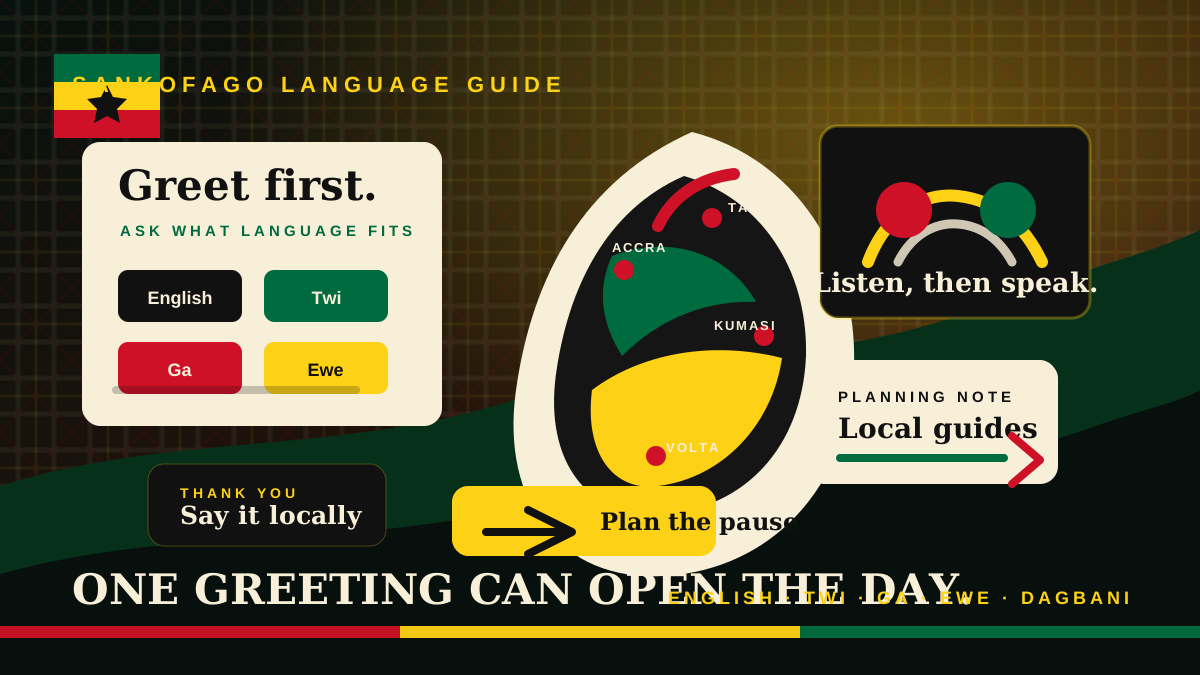
The short answer: English works, greetings deepen the trip
A traveler can visit Ghana successfully with English alone. Ghana's Ministry of Tourism, Culture and Creative Arts describes English as the country's official and instructional language, while noting that many Ghanaians also speak one or two indigenous languages in addition to their mother tongue and English. That mix is exactly what visitors experience: official processes in English, everyday warmth in local languages, and quick code-switching in markets, taxis, churches, homes, and family gatherings.
This guide is not a repeat of SankofaGo's broad etiquette guide, naming ceremony guide, hometown visit guide, Accra neighborhood guide, food guide, or region guides. Those explain manners, family protocol, route planning, and place-specific travel. This article answers a narrower question: what should a visitor understand about Ghanaian languages before trying greetings, asking for help, visiting family, or moving between Accra, Kumasi, Volta, Tamale, the coast, and smaller towns?
- Use English for official travel, bookings, immigration, most hotel communication, and written confirmations.
- Learn one or two greetings for the region you are visiting instead of trying to perform many languages badly.
- Ask "How do you say hello here?" before assuming Twi is the right choice everywhere.
- Let pronunciation be corrected kindly; tone, rhythm, and local usage matter more than a memorized spelling.
- Use local greetings as respect, not as a shortcut into private culture, sacred spaces, or family authority.
Why Ghana is not a one-language country
Ghana's language life follows the country's history, ethnic diversity, migration, education, trade, religion, and family networks. The Ghana Statistical Service 2021 Population and Housing Census says three of the nine major ethnic groups - Akan, Mole-Dagbani, and Ewe - constitute more than three-quarters of the population. The same report defines ethnicity as a grouping connected by common language, culture, history, identity, or mother tongue.
That does not mean language maps neatly onto every person you meet. Greater Accra, Kumasi, Takoradi, Tamale, Cape Coast, university towns, markets, airports, and diaspora family networks are multilingual. A person may speak English at work, Twi with one customer, Ga or Ewe at home, Hausa in a trading context, and another Ghanaian language with family.
The Bureau of Ghana Languages describes its work as promoting the preservation of Ghanaian languages and culture through publication, certification, usage systems, technology, and collaborations. Ghana's Information Services Department reported on August 10, 2026 that Ghana had moved from 11 to 16 standardised Ghanaian languages as Bureau restructuring advanced. For travelers, the lesson is simple: Ghanaian languages are living systems, not tourist decoration.
Which language helps in which travel setting?
Twi is often the first local language travelers hear about because Akan is widely spoken and because the Ministry of Tourism says Akan functions as a de facto national language for intergroup communication. Twi can be useful in Kumasi, parts of Ashanti and Eastern regions, many Accra interactions, markets, transport conversations, and family settings where Akan language is present.
Ga is especially meaningful in Accra because Accra sits within Ga-Dangme cultural space, even though the capital is highly mixed. If your trip includes Jamestown, Osu, La, Labadi, Teshie, Nungua, Ga family visits, Homowo-related planning, or older Accra neighborhoods, asking for a Ga greeting can show that you understand Accra is not culturally blank just because English and Twi are common.
Ewe becomes more useful as you move through Volta and parts of Oti, and it is also heard in Accra and other cities because people move, trade, study, and marry across regions. Visit Ghana's Oti Region page lists Guan, Twi, and Ewe among major languages spoken there. A Volta route to Ho, Wli, Tafi Atome, Keta, or family towns should make space for Ewe greetings and local guidance.
Northern Ghana needs its own language respect
Do not carry a southern Ghana language assumption into northern Ghana. Visit Ghana's Northern Region page lists Dagbani, Gonja, and Anfuo as predominantly spoken languages, while its Savannah Region page says Gonja is primary in the Gonja Kingdom and lists Vagla, Dagbani, and Mamprusi as other prominent languages. Tamale, Yendi, Damongo, Mole, Larabanga, Salaga, and northern family routes deserve their own linguistic humility.
That humility matters because language is tied to chieftaincy, religion, family identity, greetings, public events, and how elders expect to be addressed. A visitor who learns one northern greeting from a guide or host often receives warmer help than a visitor who assumes every Ghanaian conversation should begin in Twi.
If your trip includes a chief's palace, a courtesy call, a naming or funeral visit, a family meeting, or a festival durbar, ask your host who should speak and which greeting belongs. In some settings, the best language move is not speaking first. It is waiting, listening, and letting the right person introduce you.
A few phrases worth learning carefully
Phrase lists can help, but they can also mislead. Ghanaian languages have dialects, tones, spellings, and social context. A phrase that is warm in one setting may sound odd in another, and an online spelling may not match how your host says it. Treat the examples below as conversation starters, not final authority.
In many Akan/Twi-speaking contexts, travelers commonly hear or learn "Akwaaba" for welcome, "Medaase" for thank you, "Maakye" for good morning, and "Ete sen?" for how are you. In Ewe-speaking contexts, "Akpe" is a common thank-you word. Spellings and pronunciation can vary, so ask someone local to say the word slowly, repeat it back, and accept correction without turning it into a performance.
The safest universal phrases are often English plus respect: "Good morning," "Please," "Thank you," "May I ask?", "How do I greet here?", and "Please correct me." In Ghana, the attempt matters most when it is paired with patience, eye contact, and a willingness to be taught.
- Learn "thank you" for the area where you will spend the most time.
- Learn the morning greeting before the afternoon greeting; travel days start early.
- Learn how to address an elder, driver, guide, auntie, uncle, chief, or queen mother before a formal visit.
- Avoid joking with sacred titles, stool names, clan names, or private family names you do not understand.
- Use phrase apps as a backup, but trust your host or licensed local guide over a generic translation result.
Common traveler mistakes with Ghanaian languages
The first mistake is assuming Twi equals Ghana. Twi is useful, but Ghana is larger than one language. The second mistake is asking someone to "teach me Ghanaian," which accidentally erases the actual language they speak. Ask for the language by place or person: "What language do people greet in here?" or "How should I greet your mother?"
The third mistake is rushing straight into business. Even in English, greetings are not empty filler. They create the social path for asking directions, negotiating politely, entering a shop, meeting a family, or checking on a driver. A few seconds of "Good morning, how are you?" can change the whole tone of an interaction.
The fourth mistake is overusing local words in serious spaces. At a palace, funeral, family elder meeting, religious site, or heritage visit, let your host lead. If you are unsure, a respectful English greeting and quiet body language are better than a loud phrase delivered with misplaced confidence.
How language changes route planning
Language should shape who guides the day, not just what words you memorize. A Cape Coast heritage day may be easier in English for museum interpretation, while a family-town visit may need a relative or local fixer who can move between English and the family language. A Kumasi route may benefit from Akan fluency; a Volta village visit may need Ewe support; a northern route may call for Dagbani, Gonja, Mamprusi, or another local language depending on the town.
For diaspora and homecoming travelers, this can be emotional. Not speaking an ancestral language does not make the trip less valid. Many families have lost, shifted, mixed, or changed language across generations, migration, colonial schooling, urban life, and the Atlantic story itself. The respectful aim is reconnection, not passing a fluency test.
Mid-article planning note: start at /plan and ask Nana for a "language-aware Ghana route." Share your regions, family towns, ceremonies, elders, markets, heritage sites, food interests, mobility needs, and whether you want a guide who can interpret local greetings. SankofaGo can help match the trip to the people you hope to meet, not just the places on a map.
When to hire a local guide or interpreter
Hire language support when meaning matters: family introductions, chief or queen-mother courtesy calls, land or business meetings, oral-history interviews, hometown visits, funeral attendance, naming ceremonies, market sourcing, rural routes, or research trips. A good guide is not only translating words. They are reading tone, sequence, status, joking boundaries, and when a question should wait.
Use caution around legal, medical, immigration, land, investment, or business matters. A travel guide can interpret everyday conversation, but they should not replace a lawyer, doctor, licensed immigration adviser, surveyor, or official translator where formal decisions are involved. Keep written confirmations in English for bookings, prices, pickup times, inclusions, cancellation rules, and emergency contacts.
SankofaGo should not promise fluency in every Ghanaian language or guarantee how a family, palace, market, or public office will respond. The truthful value is preparation: choosing the right local support, briefing travelers on greetings, protecting time for introductions, and helping visitors move through Ghana with less confusion and more care.
How SankofaGo helps you travel with language humility
A language-aware itinerary is calmer because it anticipates where English is enough and where local help changes everything. It gives your driver the right pickup notes, your guide the right cultural brief, your family visit the right pacing, and your market day enough patience for greetings before bargaining.
If language is part of your Ghana trip, do not leave it as a last-minute phrase search in the car. Visit /pricing to choose the planning support that fits, then go to /plan and tell Nana which regions, towns, family connections, ceremonies, or meetings matter. We will help you plan for the words, people, and pauses that make the journey feel human.
Frequently asked questions
Do tourists need to speak Twi to visit Ghana?
No. English is Ghana's official language and is widely useful for travel, bookings, airports, hotels, restaurants, and many attractions. Twi can help in many Akan-speaking or mixed urban settings, but it is not the only Ghanaian language and should not be treated as universal.
What language is spoken in Accra?
Accra is multilingual. English is used formally, Twi is commonly heard, and Ga is culturally important because Accra sits in Ga-Dangme space. You may also hear Ewe, Hausa, Fante, Dagbani, Nigerian languages, French, and other languages because the capital is a regional hub.
What is the best Ghanaian greeting for travelers to learn?
The best greeting is the one that fits the place and person. "Good morning" in English is always useful. If you are in a Twi-speaking setting, ask a local person to teach you the morning greeting and thank-you phrase. In Volta, northern Ghana, or Ga communities, ask for the local greeting instead of assuming Twi.
Is Akwaaba Twi or Ghanaian?
"Akwaaba" is commonly used as a welcome expression in Akan/Twi contexts and is widely recognized in Ghana tourism. It is not the only way people welcome visitors in Ghana, because different languages and communities have their own greetings.
Should I use a translation app in Ghana?
A translation app can help with simple words, but it should not replace a local person for ceremonies, family conversations, business, land, legal, health, or official matters. Ghanaian languages can involve tone, context, dialect, respect levels, and idioms that generic tools may miss.
When should I hire an interpreter or local guide?
Hire language support for hometown visits, family introductions, oral-history research, chief or queen-mother calls, funerals, naming ceremonies, rural routes, market sourcing, or any conversation where misunderstanding would affect relationships, money, timing, or respect.
Sources & further reading
- Ministry of Tourism, Culture and Creative Arts - Culture
- Bureau of Ghana Languages - FAQs
- Information Services Department - Ghana moves from 11 to 16 standardised languages
- Ghana Statistical Service - 2021 PHC Background Characteristics
- Ghana Tourism Authority - Northern Region
- Ghana Tourism Authority - Savannah Region
- Ghana Tourism Authority - Oti Region
- Ghana Tourism Authority - Western Region
- National Commission on Culture - About Us
Ready to see it for yourself?
Plan your Ghana trip free with Nana, our AI planner — then our team books every car, hotel, and guide. You just confirm, pay, and go.
Start planning — it's free