
Old Navrongo Cathedral Guide: Mud Architecture, Faith & Respect
The short answer: the Old Navrongo Catholic Cathedral is an earthen church in Navrongo, Ghana’s Upper East Region, where mud-brick construction and Nankani-Kassena visual traditions meet a continuing Catholic worship life. Ghana Museums and Monuments Board says the building was completed in 1920, is still used for worship, and has walls decorated by women from the Navrongo community. Visit it as a living religious and community space—not as an empty monument: confirm whether a visit is welcome on your date, dress and speak modestly, ask before taking any photo, and make the church’s schedule the priority.
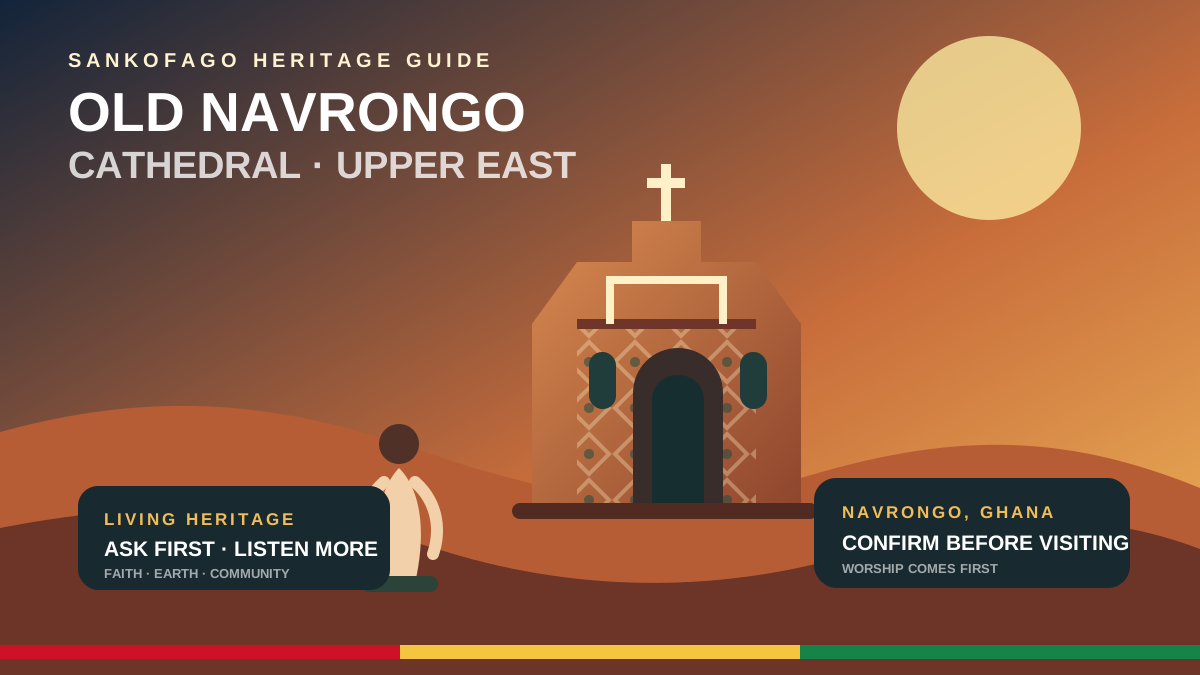
What makes the Old Navrongo Cathedral significant
The Old Navrongo Catholic Cathedral is not remarkable because it imitates a European church. Its importance lies in the way it brings Catholic worship into a building made with local materials and techniques. Ghana Museums and Monuments Board describes a structure built entirely of mud bricks and mud mortar, with a compacted floor of gravel, cowdung, and dawa-dawa. It also records a 60-metre-long, 14-metre-wide building with a 13-metre bell tower. Those details help visitors notice the building as architecture shaped by place, climate, skill, and care.
The walls add another layer. GMMB says women in the Navrongo community began creating the mix of Nankani-Kassena imagery and Catholic symbolism in 1973. Look closely only where you are invited to do so: the painted forms are not generic “African patterns,” and the church does not need to be treated as a set for portraits. A quiet question to a local host or church representative will teach more than a hurried photo session.
UNESCO lists Navrongo Catholic Cathedral on Ghana’s cultural tentative list, submitted by the Ghana Museums and Monuments Board. Tentative-list status is not the same as World Heritage inscription. It is a useful heritage context, but it should never be used to overstate the site’s designation or to make promises about visitor facilities.
- Look for: earthen walls, the central bell tower, the long interior plan, and the dialogue between local imagery and Catholic symbolism.
- Do not assume: public interior access, a guide, a fixed admission fee, photography permission, a museum display, or a particular service time.
- Best for: travelers who value architecture, faith, community history, and an unhurried Upper East itinerary.
Plan the visit around worship, not around a sightseeing clock
GMMB states that the old building is still used for worship. That is the planning fact that matters most. A service, funeral, wedding, parish activity, maintenance work, or private community need may take precedence over tourism, and it should. Before travelling, contact the parish or the Navrongo-Bolgatanga Diocese to ask whether a short, respectful visit is possible and what time would cause the least disruption. The diocesan website identifies Our Lady of Seven Sorrows in Navrongo; use a current church contact rather than relying on an old blog schedule.
Arrive with shoulders and knees covered, a calm voice, and enough time to accept a “not today” answer without pressure. Remove a hat if a host asks, keep phones silent, and do not wander into spaces that are closed or prepared for worship. If a service is underway, participation or observation is for the congregation and church leadership to define. Visitors who are unfamiliar with the liturgy can stand or sit quietly when directed rather than trying to perform belonging.
Photography needs an explicit yes, not an assumption. Ask before taking exterior or interior images, using a drone, filming a service, recording someone’s voice, or including children and worshippers in a frame. A permission given for a quick personal photo is not permission for a commercial shoot, livestream, social-media campaign, or a posed session. Protecting the space is more valuable than coming home with a particular image.
Fit Navrongo into an Upper East route with care
Navrongo is in the Upper East Region, a part of northern Ghana whose official regional profile identifies Bolgatanga, Navrongo, Paga, Tongo, Bongo, and other towns as important places in the region. A cathedral visit works best as one intentional stop in a route that leaves room for rest, meals, heat, and community timing. Do not turn it into a rushed checklist between distant attractions.
Travelers interested in craft can pair the region thoughtfully rather than treating every community as a shop. Our /blog/sirigu-pottery-painted-walls-guide explains how to approach Sirigu’s pottery and painted-wall traditions with more context; our /blog/tongo-hills-tengzug-shrine-guide covers the distinct protocols around Tengzug Shrine. These are different places with different custodians, so carry the same habit—ask first, listen, and let each community set its own terms.
If you are building an Upper East journey that also includes Paga, allow the schedule to remain flexible and verify each place separately. The sacred-crocodile site, border-area logistics, and church visit each have their own live conditions. SankofaGo can help sequence transport and overnight pacing through /plan, while site custodians and local authorities remain the source of truth for access, ceremonies, permissions, and safety conditions.
- Before departure: confirm whether the old cathedral can receive visitors, the correct contact, and the appropriate arrival window.
- For the road: use a current driver or transport plan, carry water, and avoid fixing an unchangeable itinerary around one short visit.
- For a group: ask in advance about size, children, accessibility needs, photography expectations, and whether a donation is appropriate; do not presume any amount or obligation.
How to make the visit meaningful without overclaiming it
A respectful visit can be very simple: arrive when welcomed, notice how earth, light, paint, and worship share the space, and leave it as you found it. If a knowledgeable local person is available, ask what they feel comfortable explaining about the building’s materials, decoration, parish history, or present-day use. Avoid turning a single answer into a sweeping statement about every Nankani or Kassena family, every Ghanaian Christian, or the whole Upper East Region.
The building’s history calls for precision. GMMB says three missionaries arrived at the then English military garrison in April 1906, records earlier chapels in 1907 and 1910, and dates completion of the cathedral to 1920. UNESCO’s tentative-list description refers to the 1906 mission and the local construction context. These sources are useful starting points, but the old cathedral is more than a timeline: it remains a community space with relationships and responsibilities that cannot be captured by a date alone.
For diaspora travelers, the value may be in seeing Ghanaian creativity and faith practiced in the present, rather than searching for a scripted “roots” moment. For all visitors, humility is the better approach. Leave room for the possibility that the most responsible decision is to admire the exterior, thank the person who helped, and continue your journey without asking for more access than the day allows.
Frequently asked questions
Where is the Old Navrongo Catholic Cathedral?
It is in Navrongo in Ghana’s Upper East Region. Confirm the current parish directions and the correct entrance with the church or a local host before setting out.
Can tourists visit the Old Navrongo Cathedral?
A visit may be possible, but the building is still used for worship. Contact the parish or Navrongo-Bolgatanga Diocese first, and do not assume interior access, a guide, a fee, or a visiting schedule.
Why is the Old Navrongo Cathedral important?
Ghana Museums and Monuments Board describes it as a mud-brick cathedral with local construction materials and Nankani-Kassena imagery created by women in the Navrongo community. It is also on Ghana’s UNESCO cultural tentative list, not the World Heritage List.
Can I take photos at the Old Navrongo Cathedral?
Ask for clear permission first. Never assume photography, filming, drone use, or images of worshippers are allowed, especially during a service or community event.
Can SankofaGo help plan an Upper East Ghana trip?
Yes. Start at /plan with your dates, group size, arrival point, pace, accessibility needs, and interests. SankofaGo can help shape a realistic transport and overnight plan; local custodians confirm all site-specific access and permissions.
Sources & further reading
- Ghana Museums and Monuments Board — Old Navrongo Catholic Cathedral Building
- UNESCO World Heritage Centre — Navrongo Catholic Cathedral, Ghana tentative list
- Navrongo-Bolgatanga Diocese — official website
- Upper East Regional Coordinating Council — About the Region
- Ghana Tourism Authority — Upper East regional contact
Ready to see it for yourself?
Plan your Ghana trip free with Nana, our AI planner — then our team books every car, hotel, and guide. You just confirm, pay, and go.
Start planning — it's free