
Tongo Hills & Tengzug Shrine Guide: Bolgatanga Route & Respect
The short answer: Tongo Hills and Tengzug Shrine are worth planning when your Ghana trip reaches Bolgatanga, Paga, Sirigu, Tamale, or a deeper Upper East Region route. Go for dramatic granite rock formations, Talensi cultural landscape, sacred shrines, caves, and a living heritage visit that requires humility. Do not treat Tengzug as a casual photo stop: confirm current access, use a local guide, understand shrine dress requirements before you climb, protect daylight road time, and be especially careful with northern-border safety advice.
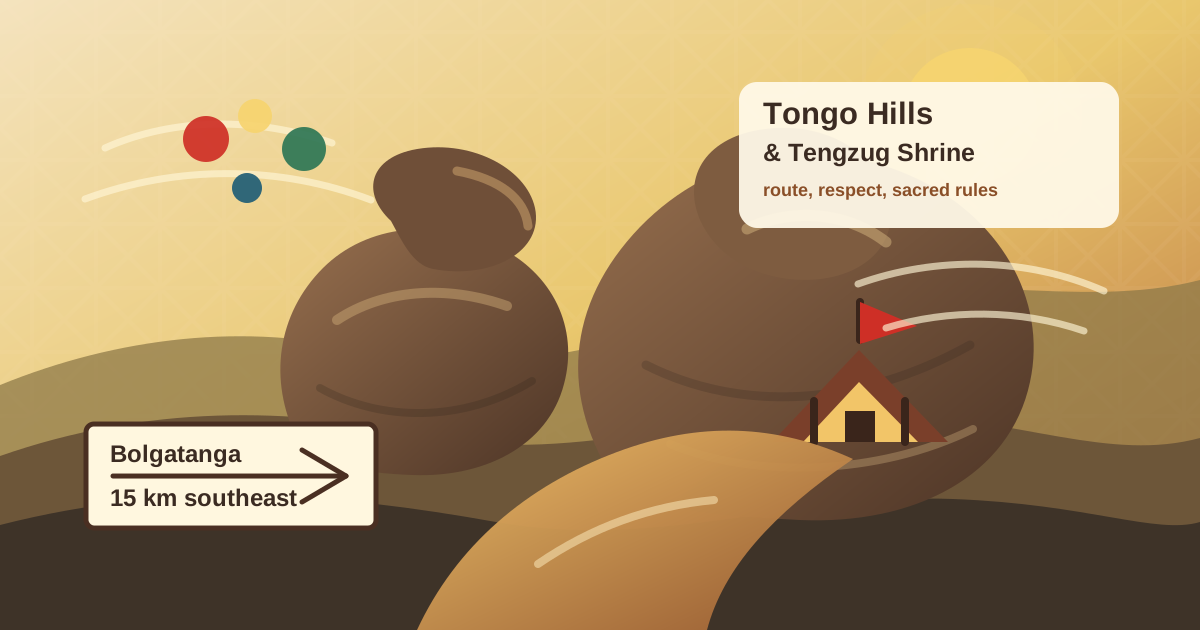
The short answer: Tongo is a sacred landscape, not only a viewpoint
Tongo Hills and Tengzug Shrine answer a different travel question from Mole, Larabanga Mosque, Paga, Pikworo Slave Camp, Tamale, or SankofaGo's broad northern Ghana guides. Mole is the safari anchor. Larabanga is a mosque-and-Mole heritage stop. Paga and Pikworo focus on sacred crocodiles and slave-route memory near Ghana's far north. Tamale is the regional gateway. Tongo is a Talensi cultural landscape where rocks, caves, shrines, village life, harvest traditions, and spiritual practice sit together.
That is why the best visit starts with respect. You can enjoy the landscape, learn the history, and photograph the rocks, but shrine access is governed by local rules. Some travelers will choose not to enter the inner shrine, and that is a valid decision when made early and respectfully.
- Best fit: culturally curious travelers, northern Ghana road trips, Bolgatanga or Paga overnights, photographers who can follow consent rules, homecoming travelers interested in living traditions, and repeat Ghana visitors looking beyond the coast.
- Plan around: guide availability, current entrance fees, cash, heat, climbing comfort, shrine dress rules, photography permission, market or craft stops in Bolgatanga, and the latest safety guidance for the Upper East Region.
- Do not assume: Tongo is a quick roadside lookout, every shrine area is open to visitors, old fee details are current, or northern Ghana road days should run after dark.
- Search intent match: this is a Tongo Hills and Tengzug Shrine planning guide, not a general Upper East Region itinerary or a Paga crocodile guide.
What Tongo Hills and Tengzug Shrine are
Ghana Tourism Authority's Visit Ghana page describes Tengzug as a place where rock formations, caves, sweeping landscape, and multiple shrines combine natural beauty with cultural richness. It also notes that the site has been shortlisted for future consideration as a UNESCO World Heritage Site.
Ghana Museums and Monuments Board describes the Tongo-Tengzuk cultural landscape as balancing rock formations and Talensi ancestral shrines at and near the base of a horseshoe-shaped chain of hills. GMMB identifies the Ba'ar Tonna'ab Ya'nee shrine as the most recognized shrine and says Asante traditionalists know it as Nana Tongo.
For a traveler, the important point is not only what you see. It is where you are standing: a landscape that is scenic, religious, historical, agricultural, and still meaningful to the Talensi people who live there.
Where it is and how to place it in a northern Ghana route
GMMB places the landscape in Tengzuk, also known as Tongo, in the Talensi-Nabdam District, about 15 kilometres southeast of Bolgatanga in Ghana's Upper East Region. Visit Ghana's Upper East Region page identifies Bolgatanga as the regional capital and names Tongo-Tenzug Shrine as a major attraction alongside Paga Crocodile Pond and Sirigu Art and Pottery Village.
The cleanest travel plan is usually to sleep in or near Bolgatanga, then visit Tongo in the cooler part of the day. From there, the same Upper East chapter can include Bolga market and baskets, Sirigu, Paga, Pikworo, Navrongo, or a slower return toward Tamale. The mistake is trying to make every northern stop a rushed add-on after a long road morning.
If your trip begins in Accra, Tongo belongs in a multi-day northern plan, not a single heroic excursion. Many travelers should first reach Tamale by flight or road, continue to Bolgatanga with careful daylight timing, and then build Tongo around local guidance, weather, and group stamina.
Shrine rules: decide before you reach the cave
GMMB says the Tongo-Tengzuk tour includes a model home, hills, caves, the chief's house, and the shrine. It also states that both genders are permitted to enter the shrine, but must do so without clothing on the upper body. That requirement is not a tourist gimmick; it is a sacred-site rule.
Decide before travel whether your group is comfortable with that condition. If someone is not comfortable, tell the guide at the start. There is still value in seeing the rocks, village context, caves, chief's house area, and wider landscape without entering the inner shrine.
This is also where SankofaGo planning matters. We can help you brief a family group, elders, teens, photographers, or faith-sensitive travelers so nobody learns an intimate access rule at the last minute on a hot climb with people waiting behind them.
Rocks, caves, harmattan wind, and Talensi history
The visual drama of Tongo comes from its rock formations. GMMB describes outstanding balancing rocks around a horseshoe-shaped chain of hills, while Visit Ghana highlights the rocks, caves, and sweeping landscape as reasons enough to visit even before the shrine story is considered.
GMMB says the harmattan wind between December and February can create an interesting whistling sound as it passes through the rocks. That does not mean every visitor will hear the same sound on schedule, but it gives dry-season travelers a useful sensory detail to ask about when planning.
The caves carry historical weight too. GMMB identifies Hiding Caves associated with local resistance to British colonial attempts around 1911, plus Hyena Caves where leaders met during that conflict. Treat those places as memory sites, not only backdrops.
UNESCO status: tentative and deferred, not fully listed
Be precise with UNESCO language. GMMB's UNESCO page says Ghana's fully listed World Heritage properties are the Forts and Castles along the coast and the Asante Traditional Buildings in and around Kumasi. It lists Tengzug-Tallensi settlements on Ghana's tentative list, dated January 17, 2000.
UNESCO's 2014 World Heritage Committee decision deferred examination of the Tongo-Tangzuk Tallensi Cultural Landscape nomination and asked Ghana to develop fuller documentation, protection, management measures, capacity building, and broader comparative analysis before a revised nomination could be considered.
So the accurate traveler wording is: Tongo-Tengzuk is a serious cultural landscape with UNESCO tentative-list and nomination history, but it is not currently an inscribed UNESCO World Heritage Site. That distinction matters for trust and for search engines that quote exact claims.
What to confirm before you go
Confirm current opening arrangements, guide process, entrance and guide fees, photography rules, shrine access rules, whether any ceremonies or consultations may limit access, and what footwear or clothing your guide recommends. GMMB lists a non-Ghanaian tour fee of GHS 10 on its page, but because site fees can change, treat that as a source note rather than a promise.
Carry small Ghana cedi notes. Rural and cultural-site visits often work more smoothly when you have cash for entrance, guiding, tips, water, market purchases, rest stops, or a photography fee if one is officially requested. Ask before photographing people, homes, shrine areas, sacrifices, priests, children, consultations, or private compounds.
Mid-article planning note: start at /plan and ask Nana for a "Tongo Hills and Tengzug Shrine route." Share your dates, base city, whether you will sleep in Bolgatanga or Tamale, shrine-comfort boundaries, photography needs, heat tolerance, and whether you want Paga, Pikworo, Sirigu, Bolga market, or Navrongo in the same Upper East chapter.
Safety, roads, heat, and northern-border context
Tongo planning should be beautiful, but not naive. The U.S. Department of State Ghana Travel Advisory dated July 7, 2026 says Ghana is Level 2 overall and specifically says to reconsider travel to the northern border in the Upper East Region, the Northeast Region, the Upper West Region, and areas west of the N12 highway in the Savannah Region due to crime.
GOV.UK also warns that terrorist attacks in Ghana cannot be ruled out and highlights risks around northern border areas because armed groups operate in neighbouring Burkina Faso near Ghana's northern border. That does not automatically rule out Bolgatanga-area travel, but it means travelers should check current advice, avoid casual border detours, use trusted local transport, and stay flexible.
For road timing, GOV.UK advises longer trips outside major cities during daylight and says rural roads can be poor, with poor or absent street lighting outside main towns. For Tongo specifically, add heat and uneven rocky walking to the equation. Go early when possible, carry water, wear secure shoes for the climb, and keep the day lighter than the map makes it look.
How SankofaGo can help
Tongo is exactly the kind of Ghana stop where a thoughtful plan protects the experience. The hard part is not only getting there. It is knowing when to go, what to ask, how to brief the group, which parts of the shrine visit are optional, how to pace the climb, and how to combine Bolgatanga, Paga, Sirigu, Pikworo, Tamale, or Mole without turning a sacred landscape into a rushed checklist.
SankofaGo can help you decide whether Tongo belongs in your northern Ghana route, whether your group should sleep in Bolgatanga, how to pair the visit with craft and heritage stops, and how to keep road movement inside daylight margins. We can also help you frame the visit respectfully for family, church groups, diaspora travelers, photographers, and first-time visitors.
When you are ready, compare support levels at /pricing, then use /plan with "Tongo Hills and Tengzug Shrine" in your notes. Tell Nana whether you want a Bolgatanga-based cultural day, an Upper East heritage loop, a Paga and Sirigu pairing, or a slower northern Ghana route that leaves room for respect.
Frequently asked questions
Where are Tongo Hills and Tengzug Shrine?
Ghana Museums and Monuments Board places the Tongo-Tengzuk cultural landscape in Tengzuk, also known as Tongo, about 15 kilometres southeast of Bolgatanga in Ghana's Upper East Region.
Is Tengzug Shrine a UNESCO World Heritage Site?
No. GMMB lists Tengzug-Tallensi settlements on Ghana's UNESCO tentative list, and UNESCO deferred examination of a nomination in 2014. It is a tentative-list cultural landscape, not a fully inscribed World Heritage Site.
Do visitors need a guide at Tongo Hills?
You should plan on using a local guide. The visit involves sacred areas, caves, rocks, village context, photography boundaries, and access rules that are best handled through local guidance.
What is the shrine dress rule at Tengzug?
GMMB says both genders may enter the shrine but must do so without clothes on the upper body. Travelers who are not comfortable with that rule can still enjoy other parts of the landscape if they discuss boundaries with the guide early.
Can Tongo Hills be a day trip from Tamale?
It may be possible as part of a long road day, but many travelers will have a better experience sleeping in Bolgatanga or building it into a multi-day Upper East route. Protect daylight travel and do not overload the day with every nearby site.
What should I pack for Tongo Hills?
Bring secure walking shoes, water, sun protection, small cash, modest clothing, a light layer for dust or wind in harmattan season, and a phone or camera used only where your guide says photography is allowed.
Can SankofaGo plan a Tongo Hills and Tengzug Shrine visit?
Yes. SankofaGo can help place Tongo inside a realistic northern Ghana route, coordinate guide questions, brief your group on sacred-site etiquette, and balance Bolgatanga, Paga, Sirigu, Tamale, or Mole with daylight road timing.
Sources & further reading
- Ghana Tourism Authority / Visit Ghana - Tengzug Tongo Hills and Shrines
- Ghana Museums and Monuments Board - Tongo-Tengzuk Cultural Landscape and Sacred Shrines
- Ghana Tourism Authority / Visit Ghana - Upper East Region
- Ghana Museums and Monuments Board - UNESCO Listed World Heritage Properties
- UNESCO World Heritage Centre - Decision 38 COM 8B.17
- U.S. Department of State - Ghana Travel Advisory
- GOV.UK - Ghana safety and security travel advice
Ready to see it for yourself?
Plan your Ghana trip free with Nana, our AI planner — then our team books every car, hotel, and guide. You just confirm, pay, and go.
Start planning — it's free