
Bia National Park Guide: Rainforest, Wildlife & Route Tips
The short answer: Bia National Park is for travelers who want a wilder, less polished rainforest chapter in Ghana, not a guaranteed safari checklist. Forestry Commission describes Bia Conservation Area in the Western North Region as a 306 square kilometre twin area made up of Bia National Park and Bia Resource Reserve, with forest elephants, chimpanzees, colobus monkeys, bongo, birds, butterflies, walking trails, rough access roads, and very limited tourist infrastructure. Go with a guide, daylight road margins, proper boots, realistic wildlife expectations, and a route plan that does not depend on same-day comfort.
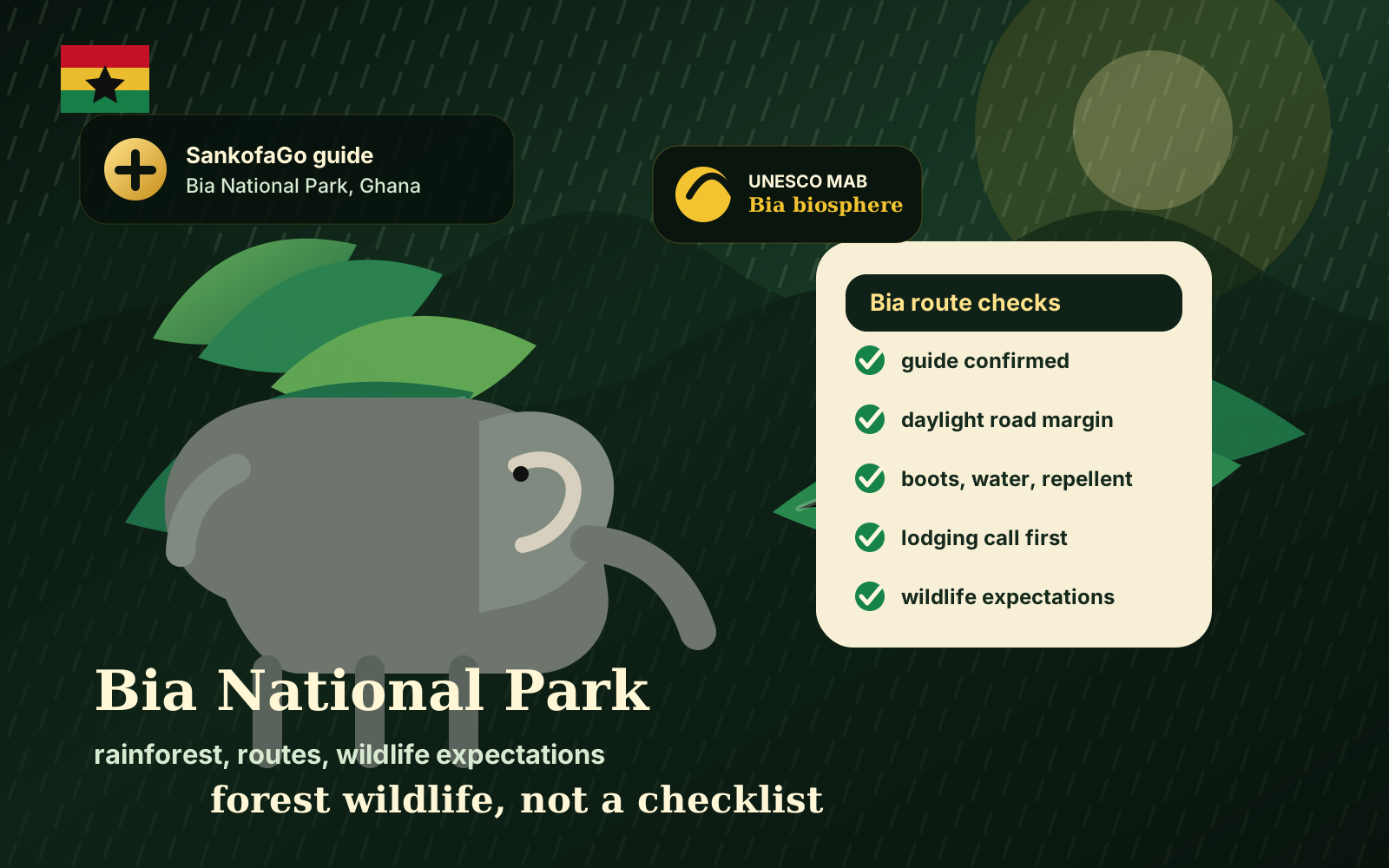
The quick answer: Bia is rainforest, not a soft stop
Bia answers a different search intent from SankofaGo's Mole safari guide, Kakum canopy walkway guide, Ankasa rainforest guide, Shai Hills day-trip guide, Ghana birdwatching guide, and Western coast articles. This guide is for travelers asking whether Bia itself belongs in a Ghana itinerary: what it is, what makes it special, how difficult the logistics are, and when another nature stop may be wiser.
The honest answer is that Bia can be rewarding for serious nature travelers, birders, researchers, repeat visitors, and slow Western North or Western Region routes. It is not the easiest first Ghana wildlife experience, and it should not be sold as a place where every traveler will see forest elephants or chimpanzees on cue.
- Best fit: birders, conservation-minded travelers, repeat Ghana visitors, nature photographers, researchers, and travelers comfortable with rougher roads and modest facilities.
- Plan around: guide availability, road condition, daylight travel, rain, walking trails, insect protection, food and water, limited lodging, and backup plans if wildlife stays hidden.
- Do not assume: Bia has Mole-style safari infrastructure, Kakum-style visitor polish, reliable animal sightings, or easy same-day access from Accra.
- Search intent match: this is a Bia National Park visitor-planning guide, not a broad Ghana national parks list.
What Bia is, in official terms
Forestry Commission places Bia Conservation Area in the Western North Region of Ghana and describes it as a twin conservation area covering about 306 square kilometres. Its public page breaks that into 77.7 square kilometres of Bia National Park in the north and about 227.9 square kilometres of Bia Resource Reserve in the south.
The same Forestry Commission page says the area sits between moist evergreen forest in the south and moist semi-deciduous forest in the north, with average annual rainfall of 1,500mm to 1,800mm and monthly mean temperatures between 24C and 28C. In travel terms, this is humid forest country: expect sweat, mud, insects, slower walks, and weather that can reshape the day.
Visit Ghana adds that Bia became a protected area in 1935 and an official national park in 1974. That older protected status matters because Bia is not a newly invented attraction; it is part of Ghana's long conservation story, even if visitor infrastructure remains limited.
UNESCO biosphere context, stated carefully
UNESCO's Man and the Biosphere Programme lists Bia in Ghana, with 1983 as the year of nomination. UNESCO describes the Bia National Park and Bia Resource Reserve as a twin conservation area and a strong example of the transition between moist evergreen and moist semi-deciduous forest types.
Current UNESCO listings show Ghana has three biosphere reserves: Bia, Lake Bosomtwe, and Songor. That is why travelers should call Bia Ghana's first UNESCO-recognized biosphere reserve when supported by Forestry Commission language, not Ghana's only biosphere reserve today.
The Ghana Commission for UNESCO also frames Bia as a biosphere reserve where conservation, cocoa-farming livelihoods, and community development intersect. That makes the visitor question bigger than "What animals can I see?" Bia sits inside a living landscape where forest protection and local livelihoods both matter.
Wildlife: what may be present versus what you should expect
Forestry Commission says Bia National Park is home to African forest elephants, chimpanzees, white-nosed sooty mangabey, olive colobus, bongo, bushbuck, 130 bird species, and 404 butterfly species. A later section of the same page says 62 mammal species have been recorded and names black-and-white colobus, red colobus, chimpanzees, forest elephant, highly threatened bongo, and more than 160 bird species.
UNESCO gives a similarly serious biodiversity picture, saying 61 mammal species and more than 200 bird species have been recorded in the Bia biosphere reserve, including chimpanzees, forest elephant, bongo, and the internationally endangered white-breasted guinea fowl.
Those numbers should inspire respect, not overpromising. Dense rainforest is not an open savanna. You may hear more than you see. Birds, butterflies, tracks, calls, trees, humidity, and forest structure may be the real experience, while larger mammals remain shy or distant.
Access, roads, and why daylight matters
Forestry Commission says access from Kumasi is through Bibiani and Sefwi Wiawso to Sefwi Asempanaye, or through Goaso, Sankore, and Sefwi Asempanaye. From Sunyani, it lists a route through Berekum, Wanfi, Adabokrom, and Debiso. The official page is blunt that the roads mentioned are not first-class roads.
Visit Ghana places Bia in the Western North Region, west of Takoradi, with road access from Kumasi via Bibiani and from Tarkwa-Sefwi via the Wiawso road. It also says the park can be visited year-round, but the long dry season from November to April is best for game viewing, while rainy periods can mean slippery roads and colder weather.
For travelers, the practical rule is simple: protect daylight, use a reliable driver, avoid last-minute road guesses, and do not build the day as if Bia were a quick detour. If the route includes Kumasi, Sefwi Wiawso, Takoradi, Ankasa, Busua, or a cocoa-country stop, let the road plan decide the pace.
Facilities, guides, and what to bring
Forestry Commission states that tourist infrastructure at Bia is currently non-existent and that the nearest overnight facility for tourists is in Sefwi Wiawso, about 100km from the park headquarters. Visit Ghana, meanwhile, says camping is allowed in designated sites and mentions Bia Guest House and Essem Debiso as accommodation options. Treat these as access details to confirm before travel, not as a reason to arrive without calls.
A guide is not optional for most visitors. Visit Ghana encourages travelers to carry comfortable walking boots, long-sleeved clothing, and a hat, and to get a tour guide for private safari-style adventures. Add water, snacks, insect repellent, rain protection, a dry bag, binoculars, any medication you need, and cash for local payments.
Mid-article planning note: start at /plan and ask Nana for a "Bia National Park route." Share your travel month, starting city, fitness level, birding or wildlife goals, tolerance for rough roads, lodging needs, and whether Bia should pair with Kumasi, Sefwi Wiawso, Ankasa, Busua, Cape Three Points, Takoradi, or a cocoa-country stop.
How Bia compares with Mole, Kakum, and Ankasa
Choose Mole National Park when the main goal is a more established wildlife route with better-known safari structure. Choose Kakum when the group wants a Central Region nature stop with canopy-walk infrastructure near Cape Coast. Choose Ankasa when a Western Region rainforest chapter fits better with beaches and Nzulezu-style routing.
Choose Bia when the traveler is comfortable with fewer conveniences and more uncertainty in exchange for a deep rainforest and biosphere-reserve story. Bia is not "better" than those stops; it is a different fit.
This distinction matters for sales honesty. SankofaGo should recommend Bia only when the traveler's goals, time, comfort level, and route can support it. A family on a first Ghana trip may be happier at Kakum or Shai Hills. A birder or conservation traveler may value Bia precisely because it is less packaged.
Safety, health, and respectful conservation travel
The U.S. Department of State Ghana advisory dated July 7, 2026 tells travelers to exercise increased caution in Ghana due to crime, poor health infrastructure, violence against women, and violence against lesbian and gay travelers. It also says medical infrastructure is limited outside Accra and advises insurance that includes medical evacuation coverage.
For Bia, the practical response is preparation: confirm road and guide arrangements, travel in daylight, keep valuables discreet, carry essential medicine, brief someone on your route, and avoid entering forest trails without local guidance. Rainforest travel also means heat, humidity, insects, slippery ground, and slower emergency response.
Conservation etiquette is part of safety. Stay on guided paths, do not chase animals, do not play animal calls without permission, do not leave litter, and avoid treating nearby cocoa-farming or forest-edge communities as scenery. The biosphere idea works only when visitors respect both nature and people.
How SankofaGo can help
Bia is exactly the kind of Ghana route where planning support matters. SankofaGo can help decide whether Bia belongs in your itinerary at all, then shape the route around daylight, road comfort, guide checks, lodging reality, food and water, fitness, weather, and the rest of your Ghana priorities.
We can also help compare Bia with Mole, Kakum, Ankasa, Shai Hills, Lake Bosomtwe, Wli, and Volta routes so you are not choosing a park from a list without understanding the tradeoffs. Sometimes the most caring itinerary decision is to choose the nature stop your group can actually enjoy.
When you are ready, compare support levels at /pricing, then use /plan with "Bia National Park" in your notes. Tell Nana whether you want a serious rainforest route, a birding-focused plan, a Western North conservation chapter, or a softer alternative with easier roads and facilities.
Frequently asked questions
Where is Bia National Park in Ghana?
Bia National Park is in Ghana's Western North Region, inside the wider Bia Conservation Area near the Juaboso-Bia landscape. Forestry Commission lists access routes through places such as Bibiani, Sefwi Wiawso, Sefwi Asempanaye, Goaso, Sunyani, Berekum, and Debiso.
Is Bia National Park a UNESCO biosphere reserve?
Bia is listed by UNESCO's Man and the Biosphere Programme, with 1983 as its year of nomination. UNESCO currently lists three Ghana biosphere reserves: Bia, Lake Bosomtwe, and Songor.
What animals are in Bia National Park?
Official sources record forest elephants, chimpanzees, colobus monkeys, mangabey, bongo, bushbuck, many bird species, and hundreds of butterfly species in the Bia area. Dense rainforest means sightings are not guaranteed.
When is the best time to visit Bia National Park?
Visit Ghana says Bia can be visited year-round, but the long dry season from November to April is best for game viewing. Rainy periods can bring slippery roads and colder weather.
Are there hotels inside Bia National Park?
Forestry Commission says tourist infrastructure is currently non-existent and points to Sefwi Wiawso as the nearest place with overnight facilities. Visit Ghana mentions designated camping, Bia Guest House, and Essem Debiso, so lodging should be confirmed before travel.
Is Bia National Park good for first-time Ghana travelers?
Usually only if the traveler is especially nature-focused and comfortable with rougher logistics. Many first-time travelers may prefer Kakum, Mole, Shai Hills, or a guided Western Region route before choosing Bia.
Can SankofaGo plan a Bia National Park visit?
Yes. SankofaGo can help compare Bia with easier nature stops, check route practicality, build daylight road timing, plan guide expectations, and connect Bia to Kumasi, Western North, Western Region, or cocoa-country travel.
Sources & further reading
- Forestry Commission Ghana - Bia National Park
- Ghana Tourism Authority / Visit Ghana - Bia National Park
- UNESCO Man and the Biosphere Programme - Bia
- UNESCO Man and the Biosphere Programme - biosphere reserves list
- Ghana Commission for UNESCO - Bia Biosphere Reserve sustainable livelihoods
- U.S. Department of State - Ghana Travel Advisory
Ready to see it for yourself?
Plan your Ghana trip free with Nana, our AI planner — then our team books every car, hotel, and guide. You just confirm, pay, and go.
Start planning — it's free