
W.E.B. Du Bois Centre Accra Guide: Pan-African History & Route Tips
The short answer: the W.E.B. Du Bois Centre in Accra is best planned as a reflective Pan-African heritage stop, not a rushed photo errand. Go during posted visitor hours, choose a guided tour if available, leave time for the former home, library context, memorial grounds, and mausoleum, and pair it with nearby Accra history only if your group has enough emotional room to absorb the story.
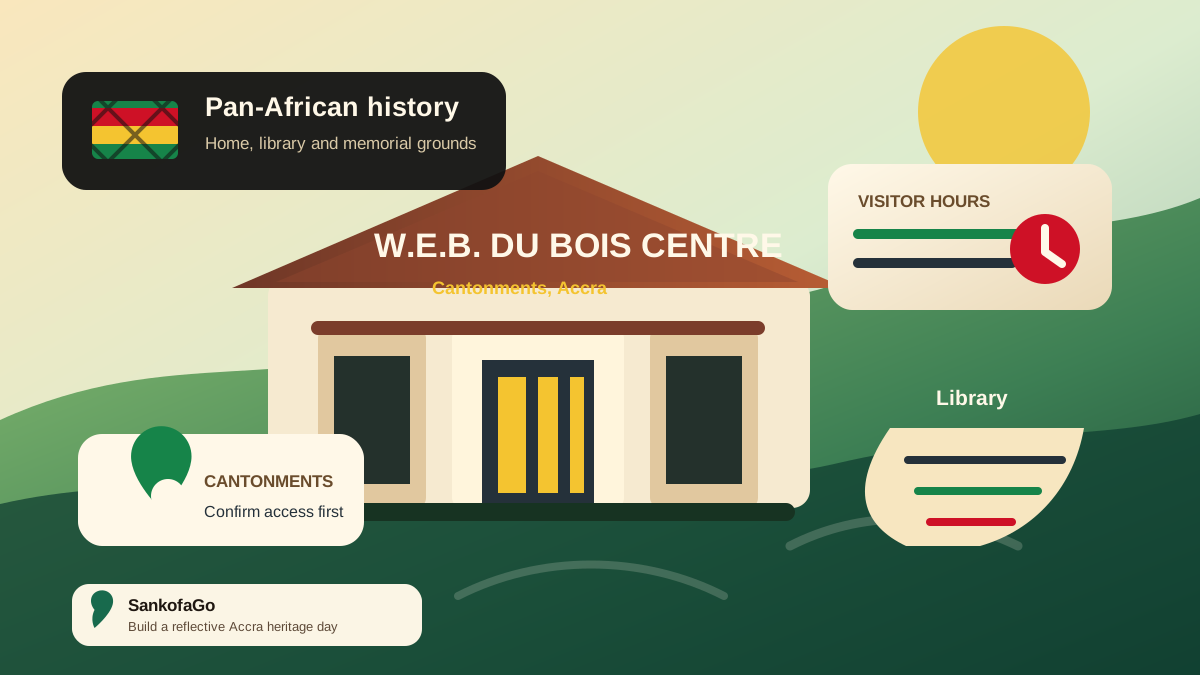
The short answer: go slowly and let the story breathe
This guide is different from SankofaGo's Kwame Nkrumah Memorial Park, National Museum, Black Star Square, Ghana National Mosque, Accra forts, ancestry research, PANAFEST, and Right of Abode posts. Those guides answer broader independence, museum, civic, religious, coastal, research, festival, or legal-status questions. This post answers one focused search intent: how should travelers visit the W.E.B. Du Bois Centre in Accra with historical respect and realistic route planning?
The practical answer is to treat the Centre as a quiet anchor in an Accra heritage day. It is in Cantonments, it preserves Du Bois's final Ghana residence and resting place, and it is connected to ongoing Pan-African education and redevelopment work. A good visit balances history, reflection, practical timing, and respect for a site that remains meaningful to scholars, diaspora travelers, students, and Ghanaians.
- Best fit: diaspora homecoming travelers, Pan-African history readers, students, civil-rights travelers, researchers, families, cultural groups, and Accra visitors who want a thoughtful indoor-outdoor heritage stop.
- Plan around: current visitor hours, weekday versus Saturday timing, guided-tour availability, heat, Cantonments traffic, photography boundaries, renovation or program changes, and nearby pairings such as National Museum, Independence Square, Kwame Nkrumah Memorial Park, or Osu.
- Do not assume: every archive or library area is open without permission, posted hours never change, the visit is only about U.S. civil-rights history, or a short stop will do justice to the emotional and intellectual weight of the site.
- Search intent match: this is a W.E.B. Du Bois Centre Accra visitor guide, not a general Accra itinerary or a full biography of Du Bois.
What the W.E.B. Du Bois Centre is
The W.E.B. Du Bois Memorial Centre for Pan-African Culture describes itself as a national monument and living memorial dedicated to the life and legacy of Dr. W.E.B. Du Bois. Its official site says the Centre was established in Accra in 1985 and preserves his former home and final resting place while serving as a hub for research, dialogue, and cultural exchange.
The Centre's own visitor page describes the site as including the museum, library, gardens, and memorial grounds in Cantonments. Visit Ghana describes the broader complex as including the home where Du Bois spent his last years, an administrative building, the Marcus Garvey Guest House, an open-air theatre, and the tombs of W.E.B. Du Bois and Shirley Graham Du Bois.
For travelers, that means the site is not just a single room of exhibits. It is a layered place: residence, memorial, library, garden, lecture and cultural-program space, and a symbol of Ghana's relationship with the African diaspora.
Current visitor basics: hours, location, and timing
The Centre's official Plan Your Visit page currently lists hours as Monday to Friday from 9:00 AM to 4:00 PM, Saturday from 10:00 AM to 3:00 PM, and Sunday closed. It gives the address as 22 First Circular Road, also noted as Fifth Link Road, in Cantonments, Accra.
Because museum programming, restoration work, public ceremonies, holidays, and private events can affect access, treat those hours as a planning baseline rather than a guarantee. Confirm same-week if your group has only one open slot, if you need research access, if you are arranging a school or diaspora group visit, or if the visit is central to your homecoming itinerary.
Weekday mornings are often the gentlest fit for travelers who want time to listen, ask questions, and sit with the memorial context. A Saturday visit can work, but the shorter window means you should avoid stacking too many nearby stops before it.
Why Du Bois belongs in a Ghana homecoming route
The Centre says W.E.B. Du Bois moved to Ghana in 1961 at President Kwame Nkrumah's invitation to work on the Encyclopaedia Africana, became a Ghanaian citizen, and died at the residence on August 27, 1963. Its history page also identifies him as a sociologist, historian, author, civil rights activist, Pan-Africanist, Harvard Ph.D., NAACP co-founder, editor of The Crisis, and organizer of multiple Pan-African Congresses.
That combination gives the site a special place in Ghana travel. Cape Coast and Elmina carry the memory of forced departure. Kwame Nkrumah Memorial Park carries Ghana's independence story. The W.E.B. Du Bois Centre helps visitors think about return, solidarity, scholarship, citizenship, and the unfinished work of Pan-African imagination.
For African American, Caribbean, Afro-Latin, Black British, continental African, student, and mixed-heritage travelers, the visit can also raise personal questions: What does home mean? What does return mean? What is the difference between heritage tourism, political memory, and everyday belonging?
What to see and how to behave
Start with the preserved home and museum context, then give time to the library story, garden setting, and mausoleum. The Centre says the mausoleum and memorial honor both W.E.B. Du Bois and Shirley Graham Du Bois, and that visitors can see academic regalia including his Harvard Ph.D. hood and honorary degrees.
Guided tours are strongly worth considering. The Centre's visitor page says guided tours are recommended for understanding the museum, library, and mausoleum, and it suggests weekday mornings for a quieter experience. A good guide can connect the objects, dates, Ghana context, and Pan-African ideas in a way that a fast walk-through may miss.
Behave as you would in any memorial space. Speak softly around the mausoleum, ask before photographing people or restricted areas, do not touch books or objects unless invited, and give researchers, staff, school groups, ceremonies, or maintenance work enough room. If a room is closed or permission is needed, accept that boundary without treating it as bad service.
Redevelopment context: expect a living site, not a frozen one
The W.E.B. Du Bois Museum Foundation says the Centre is now officially under its management and describes its mission as redeveloping and rebranding Du Bois's final resting place in Accra into a museum complex and destination for scholars, artists, and heritage tourists. Ghana News Agency reported in March 2025 that the Foundation had expressed a commitment to transforming the Centre into a world-class museum complex, including renovation of the bungalow, a new memorial, a modern museum, and research-library ambitions.
That redevelopment context is useful for travelers because it explains why the visitor experience may keep evolving. You may encounter restored areas, older infrastructure, fundraising language, events, temporary changes, or spaces that are not fully accessible yet. Rather than expecting a finished mega-museum, plan for a meaningful site in transition.
The Centre also appears in Ghana's contemporary diaspora calendar. Ghana's Ministry of Tourism, Culture and Creative Arts reported that Emancipation Day 2026 wreath-laying ceremonies included the W.E.B. Du Bois Centre, George Padmore Research Library, and Kwame Nkrumah Memorial Park. That kind of programming reinforces the site's role in Ghana's wider homecoming and Pan-African memory work.
How to pair the Centre with nearby Accra stops
The easiest pairings are nearby Accra heritage and civic sites: National Museum of Ghana, Kwame Nkrumah Memorial Park, Black Star Square and Independence Arch, Osu Castle context, Jamestown and Ussher Fort context where appropriate, or a quiet lunch in Osu, Cantonments, Labone, or Airport.
Choose one route mood. A Pan-African thought day might pair Du Bois with George Padmore Research Library context and Kwame Nkrumah Memorial Park. A first-time Accra history day might pair it with National Museum and Black Star Square. A softer diaspora arrival day might use Du Bois Centre, lunch, a hotel reset, and one evening meal rather than a crowded market sprint.
Mid-article planning note: start at /plan and ask Nana for a "W.E.B. Du Bois Centre Accra route." Share your hotel area, date, group size, ages, diaspora or student context, research interests, mobility needs, photography goals, and whether you want National Museum, Kwame Nkrumah Memorial Park, Black Star Square, Osu, Jamestown, or a quiet lunch paired with the visit.
Safety, traffic, and practical comfort
The U.S. Department of State Ghana advisory dated July 7, 2026 tells travelers to exercise increased caution due to crime, poor health infrastructure, violence against women, and violence against lesbian and gay travelers. GOV.UK warns that street crime such as pickpocketing and bag-snatching is increasing in Accra and advises travelers to avoid carrying valuables, be careful after nightfall, and avoid walking alone.
Cantonments is a familiar area for many visitors, but that does not remove ordinary city precautions. Use known transport, agree on a pickup point, keep phones and cameras low-profile outside the compound, avoid wandering alone after dark, and give traffic time around Embassy, Airport, Osu, Labone, and central Accra corridors.
Comfort matters too. The visit mixes indoor, garden, and memorial spaces, so bring water, sun protection, simple walking shoes, and a light layer if your group gets cold in air-conditioned rooms. If elders, children, disabled travelers, or emotionally tender homecoming guests are in the group, build a rest stop after the visit rather than rushing straight into another heavy site.
How SankofaGo can help
SankofaGo cannot guarantee access, set opening hours, approve research-library use, control renovation timing, or authorize photography. The Centre, its managers, and event organizers decide what is open and appropriate on the day.
What we can do is make the visit fit the human purpose of your trip: confirm the right timing questions, place Du Bois Centre in the right Accra sequence, arrange sensible transport windows, avoid emotional overload, choose nearby pairings, and shape the day for diaspora travelers, students, elders, families, researchers, or first-time Ghana visitors.
When you are ready, compare support levels at /pricing, then use /plan with "W.E.B. Du Bois Centre Accra" in your notes. Tell Nana whether you want a focused Pan-African history stop, a diaspora homecoming day, a student learning route, a soft first-day Accra itinerary, or a deeper heritage sequence with Kwame Nkrumah Memorial Park, National Museum, Black Star Square, and Cape Coast later in the trip.
Frequently asked questions
Where is the W.E.B. Du Bois Centre in Accra?
The Centre is at 22 First Circular Road, also noted as Fifth Link Road, in Cantonments, Accra. It sits in a quieter diplomatic and residential district that pairs well with nearby Accra heritage stops.
What are the W.E.B. Du Bois Centre opening hours?
The official visitor page currently lists Monday to Friday from 9:00 AM to 4:00 PM, Saturday from 10:00 AM to 3:00 PM, and Sunday closed. Confirm before going because events, holidays, restoration work, and programming can affect access.
What can visitors see at the W.E.B. Du Bois Centre?
Visitors can expect museum and former-home context, library and Pan-African history interpretation, gardens, memorial grounds, and the mausoleum honoring W.E.B. Du Bois and Shirley Graham Du Bois. Access to some spaces may depend on permissions or current site operations.
Why is W.E.B. Du Bois buried in Ghana?
The Centre says Du Bois moved to Ghana in 1961 at President Kwame Nkrumah's invitation to work on the Encyclopaedia Africana, became a Ghanaian citizen, and died at his Accra residence on August 27, 1963.
Is the W.E.B. Du Bois Centre being renovated?
Yes, the Du Bois Museum Foundation and Ghana News Agency have described redevelopment ambitions for the site, including restoration of the bungalow, a modern museum, a memorial, and research-library work. Travelers should expect a meaningful site that may continue to evolve.
How long should I spend at the W.E.B. Du Bois Centre?
Plan at least 60 to 90 minutes for a calm visit, and longer if you want a guided tour, reflection time, research questions, or a group discussion. Avoid squeezing it into a rushed city checklist.
Can SankofaGo plan a W.E.B. Du Bois Centre visit?
Yes. SankofaGo can help with route timing, transport, nearby pairings, pacing, and the right access questions, while the Centre and its managers control opening hours, tours, events, research access, and photography rules.
Sources & further reading
- W.E.B. Du Bois Centre Ghana - Plan Your Visit
- W.E.B. Du Bois Centre Ghana - Home
- W.E.B. Du Bois Centre Ghana - About the Centre
- Ghana Tourism Authority / Visit Ghana - W.E.B. DuBois Centre
- W.E.B. Du Bois Museum Foundation - Official site
- Ghana News Agency - W.E.B. Du Bois Centre to be transformed into world-class museum
- Ministry of Tourism, Culture and Creative Arts - Emancipation 2026 wreath-laying ceremony
- U.S. Department of State - Ghana Travel Advisory
- GOV.UK - Ghana safety and security travel advice
Ready to see it for yourself?
Plan your Ghana trip free with Nana, our AI planner — then our team books every car, hotel, and guide. You just confirm, pay, and go.
Start planning — it's free