
Bolgatanga Basket Market Guide: Buying Bolga Baskets Well
The short answer: Bolgatanga is the best Ghana trip stop when you want Bolga baskets close to the craft communities behind them, not only as souvenirs on an Accra shelf. Visit Ghana says Bolgatanga, the Upper East regional capital, is renowned for handicrafts such as straw hats, baskets, cloth, and jewelry, while Ghana Export Promotion Authority describes the Upper East Region as home to Ghana straw basket products and notes that communities in Bolgatanga Municipal, Bongo, Nabdam, and Talensi districts are engaged in basket weaving. Go with cash, space in your luggage, daylight route planning, respect for artisans, and current safety checks for any Upper East itinerary.
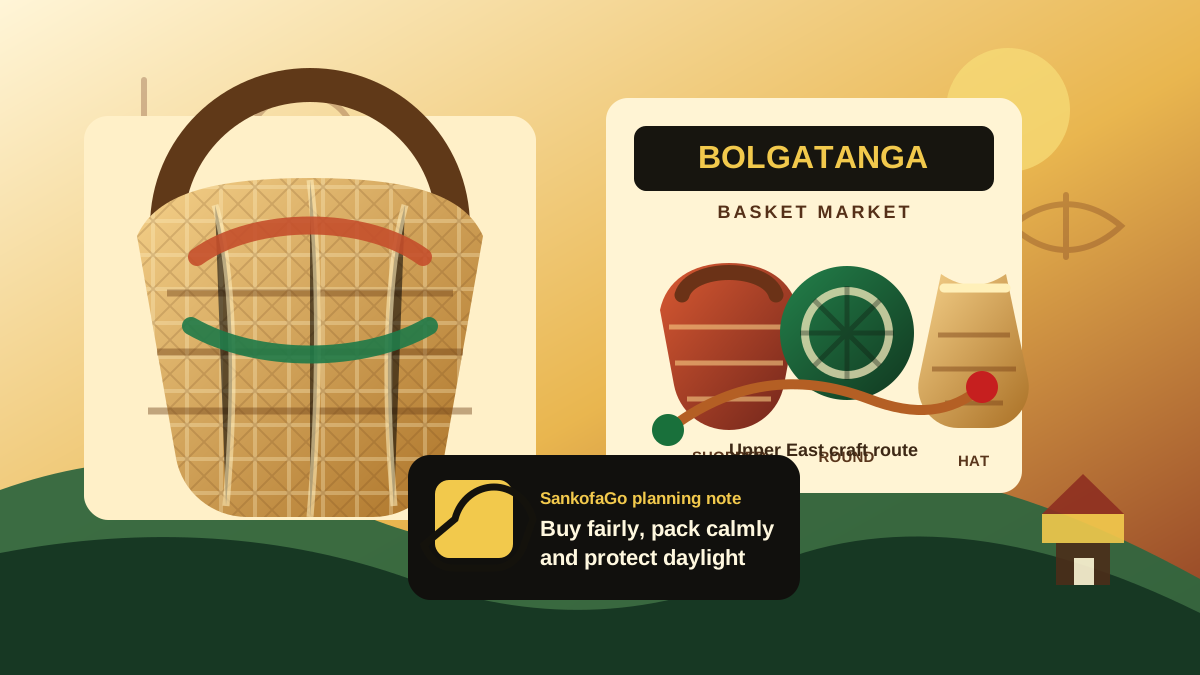
The quick answer: buy baskets where the route makes sense
This guide answers a different search intent from SankofaGo's souvenir shipping guide, Ntonso adinkra guide, Bonwire and Adanwomase kente guide, Paga and Pikworo heritage route, Sirigu pottery guide, Tongo Hills guide, and Tamale northern gateway article. The question here is practical: should you travel to Bolgatanga for baskets, how do you buy respectfully, and how do you fit the stop into a northern Ghana route without treating the Upper East as a quick shopping errand?
Bolga baskets are useful, beautiful, and easy to romanticize. A better visit keeps three truths together: the craft is globally admired, the market is part of real local livelihood, and the route requires honest planning because Bolgatanga is far from Accra and near northern-border travel-advisory zones that should be checked before travel.
- Best fit: culture travelers, diaspora visitors, design lovers, serious shoppers, small groups, family travelers with room in the itinerary, and anyone already visiting Bolgatanga, Sirigu, Tongo, Paga, Navrongo, Tamale, or Mole.
- Plan around: market days, artisan availability, cash in small notes, luggage space, basket reshaping, photography permission, hot weather, daylight roads, hotel location, and current Upper East safety guidance.
- Do not assume: every basket in Ghana was bought directly from its weaver, every online price applies in person, every artisan wants photos, or Bolgatanga can be added casually to a short Accra-Cape Coast-Kumasi trip.
- Search intent match: this is a Bolgatanga basket market and Bolga basket buying guide, not a broad Upper East itinerary or a shipping-customs article.
Why Bolgatanga is the basket name travelers know
Ghana Tourism Authority's Visit Ghana page for the Upper East Region identifies Bolgatanga, often shortened to Bolga, as the regional capital and a historic meeting point for traders from Mali and Burkina Faso. It says Bolgatanga is renowned for handicrafts including straw hats, baskets, cloth, and jewelry, and that the local market, held twice a week, is ideal for visitors to bargain for unique items.
GEPA gives the export-side explanation. Its buyer portal says the classic Bolga basket has made weavers of the Bolgatanga area world famous, and that the Upper East Region is home to straw basket products in Ghana. GEPA lists varieties including U shopper baskets, round baskets, hats, fans, baby baskets, and laundry baskets.
For travelers, that means Bolgatanga is not just a cheaper place to shop. It is a better context for understanding why the basket exists, how many forms it can take, and why a purchase can matter more when the route leaves room for conversation instead of a rushed bargain.
What to look for before you buy
A good Bolga basket should feel sturdy, balanced, and useful for the purpose you have in mind. Check the handle, rim, base, and weave tension. Look at how the basket sits on the ground, whether the handle is comfortable, whether any straw ends are sharp, and whether the size still works after you imagine it inside a suitcase, overhead bin, or shipping box.
Do not buy only by color. Ask what the shape is normally used for, whether it can be reshaped after travel, and whether the seller has other sizes or patterns. If you are buying several baskets for gifts, choose with real homes in mind: market shoppers, laundry baskets, wall baskets, picnic baskets, storage baskets, baby baskets, and decorative pieces do different jobs.
If a seller explains the weave, community, or maker, listen. That knowledge is part of the value. GEPA describes basket weaving in Ghana as a vibrant industry carried out by hundreds of weavers' associations and notes that the sector provides employment and export value. The human story should stay attached to the object you carry home.
Bargaining without flattening the craft
Visit Ghana explicitly frames the Bolgatanga market as a place where visitors can bargain for unique items, so negotiation is not disrespectful by itself. The tone matters. Start with a greeting, ask questions, handle baskets carefully, and bargain within a range that still honors the work.
A good rule is to negotiate the purchase, not the person. If the price does not work for your budget, smile, thank the seller, and move on. Avoid mocking the first price, comparing every item to an Accra souvenir stall, or turning a few cedis into a contest. The trip will feel better if the seller and buyer both leave with dignity.
Carry small notes because change can be difficult, especially on busy market days. If you are buying several pieces, agree on the total clearly before packing them together. Ask for permission before photographing the seller, stall, weaving process, children, or private spaces.
How buying supports real livelihoods
GEPA says straw baskets from Ghana create employment opportunities for youth, help reduce rural-urban migration in the Upper East Region, and generate foreign currency through exports. It also says the sector is predominantly populated by rural women and provides income to many households.
Ghana News Agency reported in August 2025 that GEPA trained 60 straw basket weavers from Nyariga and Zorko in the Bongo District on new designs to improve quality for national and international markets. GNA said the training aimed to strengthen the basket value chain, unlock business opportunities for women, and improve livelihoods within the sector.
Those facts are useful because they keep the purchase from becoming vague charity language. You are buying a real product in a real market, not donating to an idea. Pay fairly, ask before taking photos, credit the place when you share the basket story, and avoid language that makes artisans sound like props for your trip.
How to fit Bolgatanga into a northern Ghana route
Bolgatanga works best as part of a northern chapter, not a long shopping detour from southern Ghana. Visit Ghana describes the Upper East Region as a historic crossroads for trans-Saharan trade and names attractions such as Paga Crocodile Pond, Tongo-Tenzug Shrine, Sirigu Art and Pottery Village, Bolgatanga Museum, Navrongo church, and Paga-Nania slave camp.
That gives travelers several route shapes. A culture-and-craft route might connect Bolgatanga baskets with Sirigu pottery. A heritage route might pair Bolgatanga with Paga and Pikworo. A landscape and sacred-site route might add Tongo Hills with local guidance. A wider north itinerary might use Tamale as the airport and service base, then move carefully toward Bolgatanga, Navrongo, Paga, or family towns.
Mid-article planning note: start at /plan and ask Nana for a "Bolgatanga basket route." Share your dates, starting city, luggage space, shopping goals, comfort with long drives, whether you want Sirigu, Tongo, Paga, Navrongo, Mole, Tamale, or a family town included, and whether your group needs a gentler pace because of heat, elders, children, or mobility needs.
Safety, roads, and current Upper East checks
Current safety guidance matters for any Upper East plan. The U.S. Department of State Ghana advisory dated July 7, 2026 rates Ghana Level 2 and tells travelers to exercise increased caution; it specifically says to reconsider travel to the northern border in the Upper East Region, the Northeast Region, the Upper West Region, and areas west of the N12 highway in the Savannah Region due to crime.
GOV.UK similarly warns that terrorist groups operate in neighboring Burkina Faso near Ghana's northern border and advises travelers to stay aware, follow local authorities, and travel during daylight for longer trips outside major cities. GOV.UK also warns that rural roads can be poor, street lighting may be weak or absent, and travel outside main towns after dark has greater accident and vehicle-attack risk.
A basket day should therefore be planned like travel, not shopping alone. Use reputable transport, protect daylight, keep valuables discreet, check local advice before moving toward border areas, avoid road improvisation after dark, and build the route around reliable lodging rather than trying to win back time with risky transfers.
Packing, reshaping, and shipping questions
Bolga baskets are often forgiving, but they still need a plan. Ask the seller how to reshape the basket after travel and whether the handle or rim needs special care. If you are flying with more than one basket, decide whether they can nest, whether one can hold soft clothing, and whether the shape will exceed airline carry-on or checked-bag limits.
For a few personal baskets, luggage may be easier than shipping. For many baskets, oversized pieces, wholesale buying, or gifts for an event, pause before purchasing everything at once. Ask about packaging, receipts, shipping options, customs rules in your home country, and whether food, plant, leather, or untreated natural-material restrictions could affect what you bring back.
SankofaGo cannot guarantee a seller, price, airline baggage decision, customs outcome, or shipping quote on a given day. What we can do is design the shopping stop around the real itinerary: enough vehicle space, a hotel base with packing time, no last-minute airport panic, and a calmer decision about what should come home with you.
How SankofaGo can help
A Bolgatanga basket stop sounds simple until you place it on the map. SankofaGo can help decide whether it belongs in your actual trip, whether Tamale, Bolgatanga, Navrongo, Paga, Sirigu, Tongo, or Mole should anchor the route, and whether shopping should be a main purpose or a thoughtful half-day inside a larger northern itinerary.
We can also help with driver timing, hotel placement, market pacing, luggage planning, photo etiquette reminders, respectful bargaining expectations, and safer daylight sequencing. If your trip includes diaspora homecoming, family visits, heritage sites, student travel, or a design sourcing goal, those needs should shape the route before the market day arrives.
When you are ready, compare support levels at /pricing, then use /plan with "Bolgatanga baskets" in your notes. Tell Nana whether you want a focused basket shopping stop, a craft-and-culture route, an Upper East family chapter, a northern Ghana extension, or a shopping plan that connects Accra purchases with their Upper East origin story.
Frequently asked questions
Where are Bolga baskets made in Ghana?
Bolga baskets are associated with Bolgatanga and surrounding communities in Ghana's Upper East Region. GEPA says communities in Bolgatanga Municipal, Bongo, Nabdam, and Talensi districts are engaged in straw basket weaving.
Is Bolgatanga a good place to buy baskets?
Yes, if your itinerary has time for northern Ghana. Visit Ghana says Bolgatanga is renowned for handicrafts such as straw hats, baskets, cloth, and jewelry, and describes the local market as a place where visitors can bargain for unique items.
What kinds of Bolga baskets can travelers buy?
GEPA lists straw basket varieties such as U shopper baskets, round baskets, hats, fans, baby baskets, and laundry baskets. Availability depends on the seller, market day, and current production.
Can I bargain for Bolga baskets?
Yes, bargaining is normal in many market settings, and Visit Ghana describes the Bolgatanga market as a place to bargain. Keep the tone respectful, use greetings, handle baskets carefully, and pay a fair price for skilled work.
Is Bolgatanga safe for tourists?
Bolgatanga travel should be planned with current advice. The U.S. State Department tells travelers to reconsider travel to northern-border areas in the Upper East Region, and GOV.UK advises daylight travel and local-security awareness for longer trips outside major cities.
Can I pack Bolga baskets in luggage?
Often, yes, especially if you buy a small number and nest them carefully. Ask the seller about reshaping and check airline size rules before buying large or multiple baskets.
Can SankofaGo plan a Bolgatanga basket route?
Yes. SankofaGo can help place a basket-shopping stop inside a realistic northern Ghana route with driver timing, hotel placement, safety checks, luggage space, market pacing, and respectful artisan etiquette.
Sources & further reading
Ready to see it for yourself?
Plan your Ghana trip free with Nana, our AI planner — then our team books every car, hotel, and guide. You just confirm, pay, and go.
Start planning — it's free