
Fort St. Anthony Axim Guide: History, Access & Route Tips
The short answer: Fort St. Anthony, also called Santo Antonio or Fort San Antonio, is a UNESCO-listed coastal fort in Axim that works best as a Western Region heritage stop paired with beach time, Nzema culture, or an Axim-to-Beyin route. Ghana Museums and Monuments Board lists the fort as open from 9:00am to 4:30pm, but travelers should confirm same-week access before driving because smaller forts can close for maintenance, staffing, safety, or local arrangements.
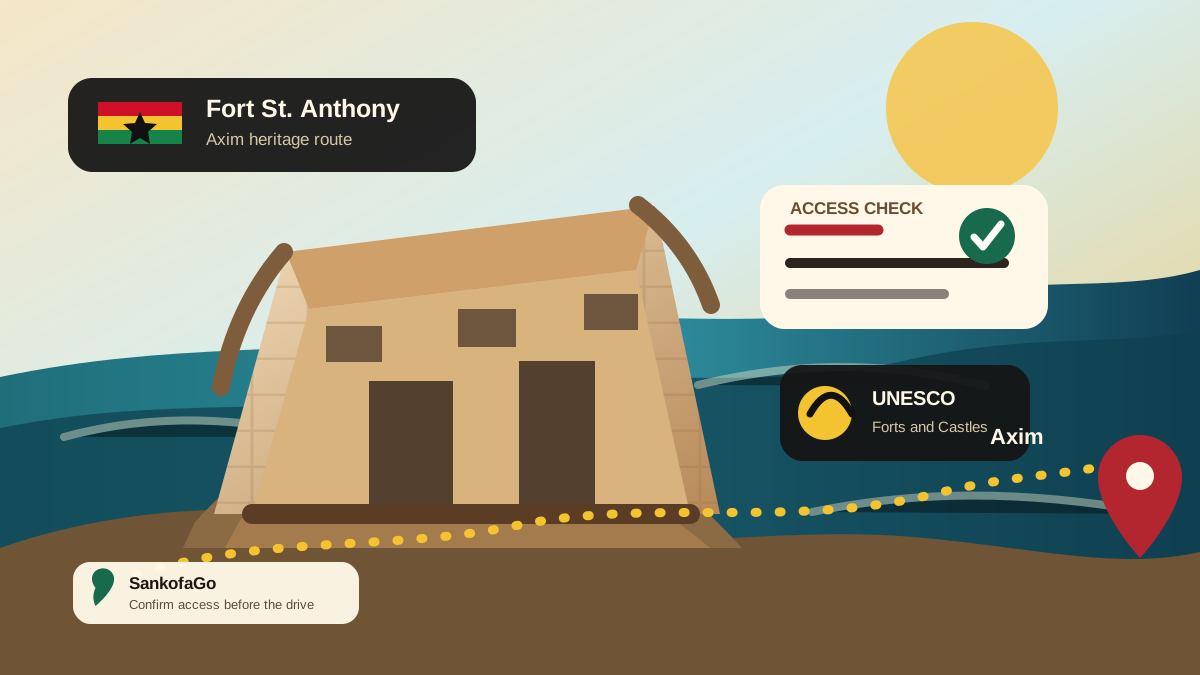
The short answer: Axim is a specific fort trip
This guide is different from SankofaGo's Cape Coast, Elmina, Fort Metal Cross, Busua and Cape Three Points, Nzulezu, Ankasa, and Western Region planning guides. Those help with broader coast, castle, beach, or rainforest decisions. This post answers the focused question: how should you plan Fort St. Anthony in Axim without treating it like a quick photo stop?
Fort St. Anthony rewards travelers who want a quieter Western Region heritage chapter. It is not the same emotional or logistical experience as Cape Coast Castle or Elmina Castle. It is a smaller site in a working coastal town, and the best visit usually includes context, access confirmation, daylight road planning, local respect, and a nearby beach or Axim overnight.
- Best fit: Western Region travelers based around Axim, Takoradi, Busua, Dixcove, Butre, Ankobra, Cape Three Points, Beyin, or Nzulezu.
- Plan around: current access, guide availability, GMMB hours and fee guidance, heat, cash, daylight roads, beach pairings, fishing-town etiquette, and emotional pacing.
- Do not assume: the fort is staffed like the larger castles, old fees are current, every room is open, photography is welcome everywhere, or your beach day can absorb a long access delay.
- Search intent match: this is a Fort St. Anthony Axim visitor guide, not a general Ghana forts list or another Cape Coast and Elmina article.
What Fort St. Anthony is, in official terms
Ghana Museums and Monuments Board describes Fort St. Anthony as a fort in Axim in Ghana's Western Region, built on a rocky promontory near the River Ankobra. GMMB says the Portuguese first built a trade post near Axim in 1503, abandoned it after repeated local attacks, and then constructed the massive triangular fort in 1515.
GMMB identifies Santo Antonio as the second Portuguese fort built on the Gold Coast after St. George's Castle at Elmina. The site was fortified for defence, including a three-metre-deep rock-cut trench on the landward side, and its position helped protect trade around the Ankobra and Tano river valleys.
That history matters for travelers because Axim is not a side note to the better-known castles. It helps explain Portuguese maritime strategy, local resistance, gold routes, later Dutch control, British transfer in 1872, and the way Ghana's western coast connected local communities to Atlantic trade systems.
UNESCO context without flattening the story
UNESCO includes St. Anthony at Axim in the World Heritage property called "Forts and Castles, Volta, Greater Accra, Central and Western Regions," inscribed in 1979. UNESCO describes the wider property as fortified trading posts founded between 1482 and 1786 along about 500 kilometres of Ghana's coast from Keta to Beyin.
UNESCO says these forts and castles served the gold trade of European chartered companies and later played a significant part in the developing slave trade and the history of the Americas. It also frames the property as a symbol of European-African encounter and the starting point of the African Diaspora.
Use that context carefully. Fort St. Anthony is part of the same coastwide system as Cape Coast and Elmina, but it has its own Axim, Portuguese, Dutch, British, gold-trade, river-valley, and coastal-town layers. A respectful visit lets the specific place speak instead of forcing every fort into the same script.
Hours, fees, and the access question
GMMB currently lists Fort St. Anthony opening hours as 9:00am to 4:30pm. The same page includes older 2013 fee figures, while GMMB's separate fees page says entrance fees for museums and heritage sites have been reviewed and groups fees into categories such as forts and regional museums. Treat the site page as historical and operational context, then confirm current charges before arrival.
The practical rule is simple: confirm access before you build the day around Axim. Call or message GMMB, ask your hotel, ask a local guide, or have your driver check locally that the fort is receiving visitors, a guide is available, and no maintenance or private-use restriction affects your date.
Ask specific questions: Is the fort open today? What are the current entrance fees? Can visitors enter the museum areas? Are photos allowed inside? Is a guide available? How long should a careful visit take? Where should a driver wait without blocking the town?
How to pair Axim with beaches and Western routes
Visit Ghana describes the Western Region as a destination for history and natural beauty, with colonial forts, beaches, vibrant towns, and coastal heritage. For travelers, Fort St. Anthony usually works best inside a slower Western Region chapter rather than as a long out-and-back from Accra.
Axim can pair naturally with Ankobra-area beach stays, Busua or Butre, Dixcove and Fort Metal Cross, Cape Three Points, Takoradi, Beyin, Fort Apollonia, or Nzulezu. The right order depends on where you slept the night before, whether your group wants swimming, how emotionally heavy fort visits feel, and how much road time you can handle in daylight.
Mid-article planning note: start at /plan and ask Nana for a "Fort St. Anthony Axim route." Share your base town, travel date, group size, beach interests, heritage priorities, whether you want Nzulezu, Beyin, Ankobra, Busua, Dixcove, Butre, or Cape Three Points nearby, and whether your group needs a softer pace after fort visits.
What to notice when you arrive
Start with the landscape. GMMB emphasizes the fort's rocky elevation and defensive position, and that is still one of the easiest ways to understand the site. Look at the sea, the promontory, the town, and the route inland before you enter the rooms and corridors.
Listen for the trade story as well as the trauma story. GMMB notes gold traders from Adanse and Denkyira came to the fort, and that the area also supplied timber and cotton for Dutch plantations. UNESCO then places the coastwide forts inside the later slave-trade history. Both layers belong in the visit.
If a guide is available, ask about the 1503 trade post, the 1515 fort, the Portuguese-to-Dutch shift, the British cession in 1872, the fort's use for offices, and the museum story. Ask what parts of the building are original, restored, closed, or repurposed before making assumptions from architecture alone.
Respect Axim as a living coastal town
Axim is not a museum set. It is a coastal town with residents, work, fishing rhythms, school routes, worship spaces, beach businesses, and ordinary privacy. The fort may be the reason you came, but the people around it are not background scenery.
Ask before photographing people, boats, homes, work areas, children, ceremonies, or sensitive spaces. Do not fly a drone without lawful permission. Do not block footpaths, stand in doorways for portraits, or turn a heritage visit into a performance for your camera.
Buy locally when it fits the day, tip guides fairly, and keep your group together without crowding residents. A respectful visit to Fort St. Anthony should leave Axim feeling seen as a place, not consumed as a location.
Safety, roads, and timing
The U.S. Department of State Ghana advisory dated July 7, 2026 tells travelers to exercise increased caution in Ghana due to crime, poor health infrastructure, violence against women, and violence against lesbian and gay travelers. GOV.UK also warns that roads can be poor outside major cities and that street lighting is often weak or absent.
For Axim, that means building the route around daylight. Avoid turning a fort-and-beach day into a late-night road transfer. Keep valuables low-profile, use known drivers or licensed transport, carry water and sun protection, and leave space for rain, road works, fuel stops, or access checks.
Beach time needs its own caution. Ghana's southern coast can have dangerous surf, rip tides, and undertows, and GOV.UK warns that swimming is dangerous on beaches along the southern coast. Ask locally before entering the water, respect warnings, and do not let a heritage day end with a careless swim.
How SankofaGo can help
SankofaGo cannot guarantee site access, set GMMB fees, authorize photography, or override local safety decisions. What we can do is design a Western Region day that does not depend on guesswork: access checks, daylight sequencing, driver timing, beach pairings, food stops, emotional pacing, and backup options if a site is closed.
We can also help decide whether Fort St. Anthony belongs in your route at all. Some travelers should prioritize Cape Coast and Elmina first. Others should choose Fort Metal Cross, Fort Apollonia, Nzulezu, Ankasa, Busua, or Cape Three Points based on where they are staying and what kind of Ghana chapter they want.
When you are ready, compare support levels at /pricing, then use /plan with "Fort St. Anthony Axim" in your notes. Tell Nana whether you want a focused Axim heritage stop, a beach-and-fort day, a Western Region slow route, an ancestry-centered coastal chapter, or a quieter alternative to the larger castles.
Frequently asked questions
Where is Fort St. Anthony in Ghana?
Fort St. Anthony, also called Santo Antonio or Fort San Antonio, is in Axim in Ghana's Western Region, on a rocky coastal promontory near the River Ankobra.
Is Fort St. Anthony part of a UNESCO World Heritage Site?
Yes. UNESCO lists St. Anthony at Axim within the World Heritage property "Forts and Castles, Volta, Greater Accra, Central and Western Regions," inscribed in 1979.
What are the opening hours for Fort St. Anthony?
Ghana Museums and Monuments Board currently lists Fort St. Anthony opening hours as 9:00am to 4:30pm. Because smaller forts can close or change access arrangements, confirm directly before traveling.
How much are Fort St. Anthony entrance fees?
GMMB's Fort St. Anthony page includes older 2013 fee figures, and GMMB's general fees page says museum and heritage-site fees have been reviewed. Confirm current fees with GMMB or locally before arrival.
Can I visit Fort St. Anthony from Busua or Takoradi?
Yes, Fort St. Anthony can fit into a Western Region route from Takoradi, Busua, Dixcove, Butre, Ankobra, or Cape Three Points, but plan daylight road margins and confirm site access first.
Is Fort St. Anthony the same as Elmina Castle?
No. GMMB says Fort St. Anthony was built by the Portuguese in 1515 after Elmina Castle. It is a different Axim site with its own Portuguese, Dutch, British, gold-trade, and Western Region context.
Can SankofaGo plan a Fort St. Anthony visit?
Yes. SankofaGo can help plan the route, access checks, driver timing, beach pairings, backup stops, and pacing. Official agencies and site managers still decide access, fees, and visitor rules.
Sources & further reading
- Ghana Museums and Monuments Board - Fort St. Anthony, Axim
- Ghana Museums and Monuments Board - Fees and charges
- UNESCO World Heritage Centre - Forts and Castles, Ghana
- Ghana Tourism Authority / Visit Ghana - Western Region
- U.S. Department of State - Ghana Travel Advisory
- GOV.UK - Ghana safety and security travel advice
Ready to see it for yourself?
Plan your Ghana trip free with Nana, our AI planner — then our team books every car, hotel, and guide. You just confirm, pay, and go.
Start planning — it's free