
Ghana Emergency Numbers Guide: Police, Ambulance, Fire & Embassy Help
The short answer: before you land in Ghana, save 112 for general emergencies, 191 and 18555 for police, 192 for fire, 193 for ambulance, your embassy emergency line, your hotel, your driver, and a GhanaPostGPS or map location for every stay. In a real incident, the first useful details are simple: what happened, where you are, who is hurt or at risk, what number can receive a callback, and which trusted local contact can meet responders.
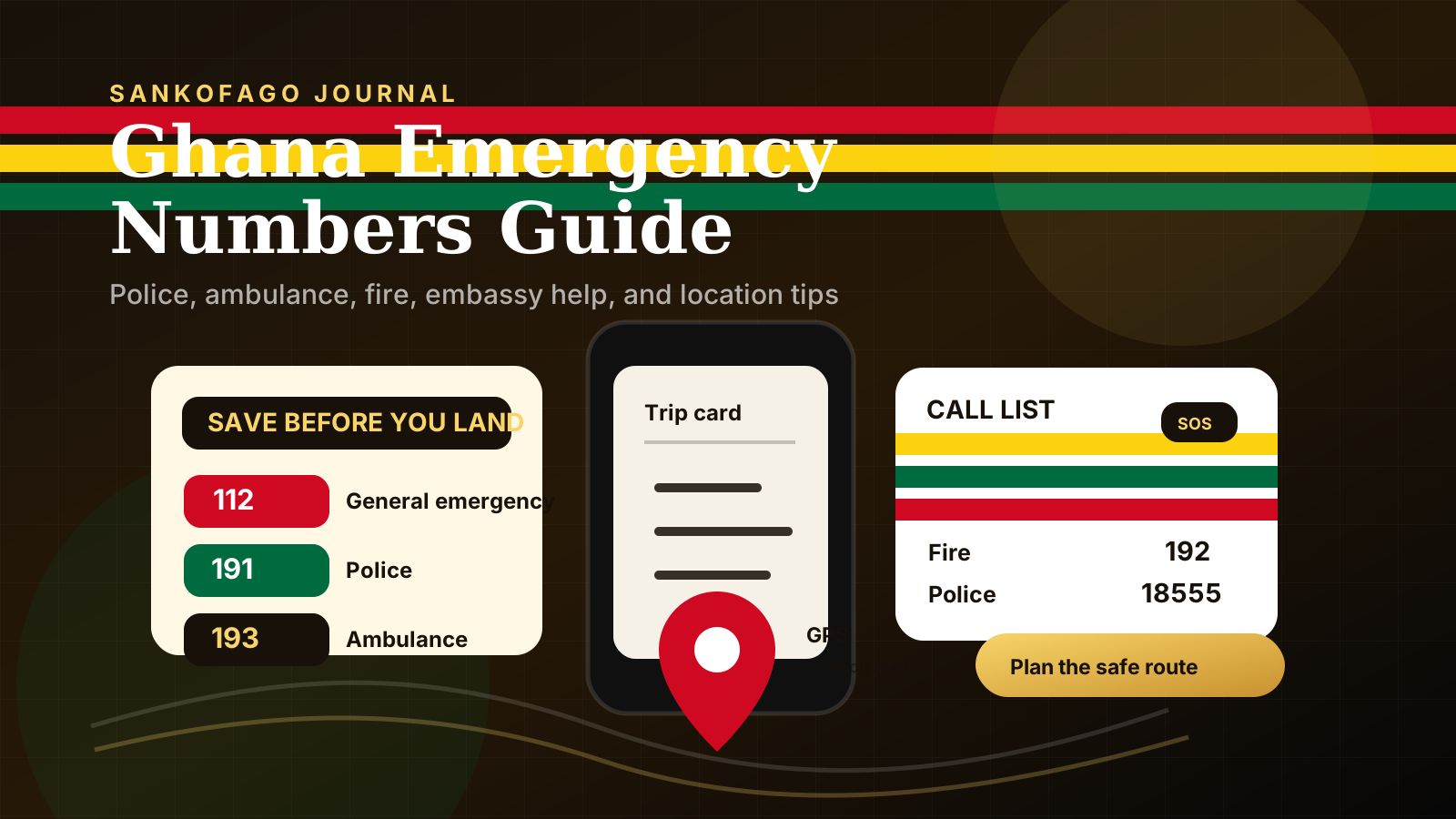
The short answer: save the numbers before you need them
Most Ghana trips do not involve an emergency, but a calm plan makes small problems easier and serious problems less chaotic. This guide is different from SankofaGo's Ghana safety guide, travel insurance guide, health guide, airport pickup guide, and GhanaPostGPS article. The search intent here is narrower: which emergency numbers should travelers save, and what should they do first if something goes wrong?
The best emergency plan is not dramatic. It is a short contact list, shared with your group, kept offline, and matched to your itinerary. Put the numbers in your phone before departure, screenshot them, write them on a card, and send them to a family member who is not traveling.
- Save first: 112 for general emergencies or when you are unsure which service to call.
- Save service-specific numbers: police 191 and 18555, fire 192, ambulance 193, plus your nearest embassy or high commission emergency contact.
- Save trip contacts: hotel front desk, driver, guide, airline, travel insurer, family contact, and SankofaGo planning thread if you are using us.
- Save locations: hotel name, neighborhood, GhanaPostGPS digital address if available, nearest landmark, and a shareable map pin.
Ghana emergency numbers travelers should save
Ghana's Ministry of the Interior lists Ghana Police Service emergency numbers as 191 and 18555, Ghana National Fire Service as 192, Ambulance Service as 193, and the Emergency Response Centre by GIFEC as 112. Its home page also frames 112 as the general emergency number for disasters, floods, humanitarian emergencies, and situations where you are unsure which service to call.
The National Ambulance Service official site also highlights 112 as the emergency hotline for medical response and says the service operates 24 hours a day, seven days a week. For travelers, that means 112 is a strong first number to remember, while 191, 192, and 193 remain useful service-specific shortcuts.
Foreign-government travel pages may present the list slightly differently. The U.S. Department of State lists 112, 191, and 18555 for police and 193 or 112 for ambulance. GOV.UK's getting-help page lists 999 or 112 for ambulance, fire, police, coast guard, and mountain rescue. Because official sources can vary, save both the general number and the Ghana service-specific numbers before your trip.
- General emergency or unsure who to call: 112.
- Police: 191 or 18555.
- Fire and rescue: 192.
- Ambulance: 193; the National Ambulance Service also promotes 112.
- Disaster response and NADMO-related help: start with 112, then follow local authority guidance.
What to say when you call
In an emergency call, clarity beats a long story. Start with the type of emergency, then the location, then the risk. Say whether the issue is medical, crime, fire, flood, crash, missing person, or immediate threat. Give the town, neighborhood, hotel, road, landmark, and digital address or map pin if you have one.
The U.S. Department of State advises travelers calling emergency services to remain calm, state their location clearly, and leave the phone line free for follow-up calls from police. The National Ambulance Service FAQ also tells callers waiting for an ambulance to keep the scene safe, follow dispatcher instructions, avoid moving seriously injured people unless absolutely necessary, and have someone guide the ambulance to the exact location.
If you are with a group, assign roles quickly: one person calls, one person watches the scene, one person finds the hotel or driver contact, one person gathers passports or insurance details if safe, and one person keeps children or elders away from traffic, crowds, water, smoke, or broken glass.
Why GhanaPostGPS and landmarks matter
Ghana directions often depend on neighborhoods, landmarks, junctions, churches, schools, fuel stations, hotels, and local place names. That can work beautifully in normal travel, but in an emergency you want a more precise backup.
GhanaPostGPS describes itself as Ghana's official digital property addressing system and says it assigns each 5-metre by 5-metre grid a unique digital address. Before a travel day, ask your hotel, apartment host, family host, or driver for the digital address and nearest landmark. Keep both, because responders, drivers, and local helpers may understand different location formats.
If you are moving between Accra, Cape Coast, Kumasi, Tamale, Volta, a beach stay, a funeral, a wedding, or a hometown visit, write down the overnight location before you leave each morning. The moment you need help is the wrong moment to discover nobody in the group knows the area name.
Medical emergencies: ambulance, hospital, insurance, and payment
For a medical emergency, call 112 or 193 and ask for ambulance help. If you are in a hotel, restaurant, airport, attraction, or family home, also ask a trusted local person to help describe the location and meet responders outside.
The U.S. Department of State warns that ambulance services in Ghana are not widely available and that response time and responder training may be limited. This is one reason travel medical insurance, medical-evacuation coverage, and a realistic transport plan matter before the trip, especially for elders, children, travelers with chronic conditions, and remote routes.
Carry the essentials offline: passport photo page, yellow fever certificate, medication names, allergies, blood type if known, insurance policy and assistance number, emergency contact, hotel contact, and any doctor letter for prescription medicine. If a group member is ill, one calm person should keep those documents ready while another speaks with medical staff.
Police, theft, road incidents, and documentation
For police emergencies, save 191 and 18555. The Ghana Police Service also publishes 191 and 18555 as police helpline numbers on official pages. For a theft, assault, road incident, missing passport, or serious threat, call police first, then involve your hotel, guide, embassy, insurer, or SankofaGo contact as appropriate.
The U.S. Department of State says local authorities are responsible for investigating and prosecuting crimes and notes that the U.S. embassy can help U.S. citizens replace a stolen or lost passport, find medical care, understand how to report a crime, contact relatives with consent, and find options to travel home. Those are support services, not a substitute for local police in an active emergency.
If documents are stolen, separate the immediate safety step from the paperwork step. First get safe. Then note the time, location, what was taken, police report process, passport-copy access, embassy contact, insurer claim steps, and whether the trip plan needs to slow down.
Fire, floods, beach incidents, and wider emergencies
For fire and rescue, save 192. The Ministry of the Interior lists 192 for Ghana National Fire Service, and NADMO safety material also tells the public to call 192 for fire emergencies. If there is smoke, electrical danger, a gas smell, structural damage, or trapped people, get out first and call from safety.
For flooding, storms, disasters, or situations where you are not sure which service fits, start with 112 and follow local authority instructions. Avoid walking or driving through floodwater, do not treat a beach or lagoon rescue like a normal swim, and take hotel or guide warnings seriously even when the sky looks calm.
GOV.UK advises daylight travel for longer trips outside major cities and, for some longer routes, traveling in a convoy of at least two vehicles. That is not only crime advice; it also affects response. A second vehicle, a known driver, and a daylight margin make breakdowns, health issues, and weather problems easier to manage.
How to build an emergency contact card
A good Ghana emergency card should fit on one phone screenshot and one printed note. Include the Ghana emergency numbers, your passport country embassy line, hotel or apartment contact, driver or guide, travel insurer, family contact, blood type or major allergy if you want it included, and the address for each overnight stay.
Mid-article planning note: if your trip includes elders, children, medical conditions, late arrivals, rural roads, beach days, festivals, weddings, funerals, or a hometown visit, start at /plan and ask Nana for an "emergency contact card." Share your cities, dates, hotels, mobility needs, driver plans, and who should be called if the plan changes.
Also decide group rules before travel: nobody leaves alone at night without telling someone, everyone keeps enough phone battery for the ride back, one person carries a power bank, and the group knows whether to call the hotel, driver, or emergency services first for common scenarios.
How SankofaGo can help
SankofaGo cannot replace Ghana's emergency services, police, ambulance, fire service, medical staff, insurers, or embassies. What we can do is reduce preventable confusion before the trip: realistic road timing, safe pickup sequencing, verified overnight locations, driver contacts, hotel questions, group pacing, and local instructions your travelers can actually follow.
For families, first-time visitors, diaspora homecomings, weddings, funerals, senior trips, and remote routes, the emergency plan should be part of the itinerary, not an afterthought. A beautiful trip still needs phone numbers, daylight margins, backup contacts, and a shared understanding of what happens if a day changes.
When you are ready, compare support levels at /pricing, then use /plan with "Ghana emergency contact card" in your notes. Tell Nana your route, group size, hotels, health concerns, late-night movements, and the contact person back home who should have a copy of the plan.
Frequently asked questions
What is the main emergency number in Ghana?
Save 112 as the general emergency number, especially when you are unsure which service to call. Also save the service-specific numbers: police 191 or 18555, fire 192, and ambulance 193.
What number should tourists call for police in Ghana?
Tourists should save 191 and 18555 for police emergencies. The U.S. Department of State also lists 112, 191, and 18555 for police help in Ghana.
What number should I call for an ambulance in Ghana?
Save 193 for ambulance service and 112 as a general emergency number. Ghana's National Ambulance Service official site highlights 112 as its emergency hotline.
Does 911 work in Ghana?
Do not rely on 911 as your Ghana emergency plan. Save Ghana-specific numbers before travel: 112, 191, 18555, 192, and 193, plus your embassy, hotel, driver, and insurer.
Should I call my embassy first in an emergency?
For an active emergency, contact local emergency services first. After you are safe, your embassy or high commission may help with passport replacement, local medical information, family contact, and other citizen services.
How do I give my location in Ghana during an emergency?
Give the town, neighborhood, road, landmark, hotel or building name, phone callback number, and GhanaPostGPS digital address or map pin if available. Ask a trusted local person to help guide responders if possible.
Can SankofaGo create an emergency contact card for my trip?
Yes. SankofaGo can help organize emergency numbers, hotel and driver contacts, overnight locations, route notes, insurance details, and family contacts into a practical trip-ready plan.
Sources & further reading
- Ghana Ministry of the Interior - emergency numbers
- Ghana Ministry of the Interior - general emergency number 112 and service numbers
- National Ambulance Service Ghana - emergency hotline 112
- National Ambulance Service Ghana - FAQ for callers waiting for ambulance help
- U.S. Department of State - Ghana travel advisory and emergency phone numbers
- GOV.UK - Ghana getting help and emergency services
- GhanaPostGPS - official digital addressing information
- NADMO Ghana - fire safety and emergency guidance
Ready to see it for yourself?
Plan your Ghana trip free with Nana, our AI planner — then our team books every car, hotel, and guide. You just confirm, pay, and go.
Start planning — it's free