
Ghana Intercity Bus Guide: STC, VIP, Luggage & Road Timing
The short answer: intercity buses can be a practical way to travel between major Ghana cities when you choose a reputable coach operator, book early, keep valuables out of checked luggage, and protect daylight margins. They are usually best for budget-aware travelers, solo travelers who do not want to negotiate a private driver, and flexible routes like Accra-Kumasi, Accra-Takoradi, Accra-Cape Coast, or Accra-Tamale. They are not the right answer for every itinerary: families with heavy luggage, tight airport connections, elders, late-night arrivals, remote heritage routes, and travelers carrying irreplaceable documents may be better served by a private car, domestic flight, or SankofaGo-coordinated route plan.
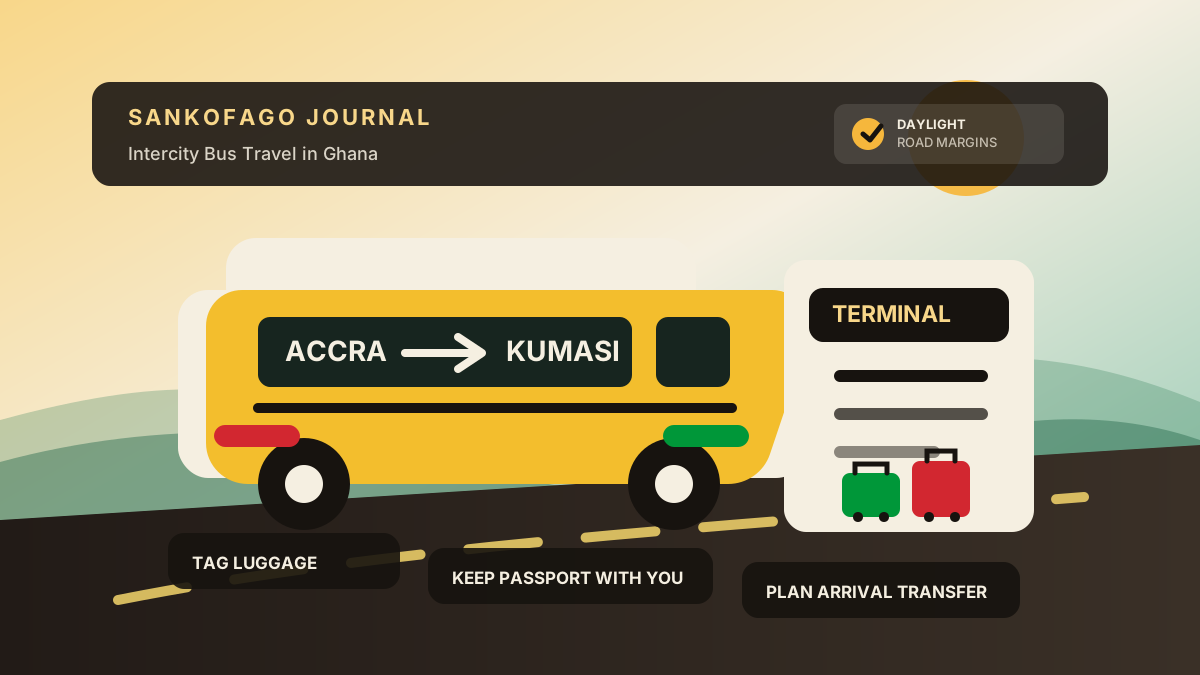
The short answer: use buses for the right routes, not every route
Ghana has several layers of road transport: private cars and hired drivers, app-based rides in bigger cities, shared taxis, tro-tros, intercity coaches, domestic flights, and specialist group buses. This guide focuses on intercity bus travel: the scheduled coach-style services travelers often consider for city-to-city movement.
That makes it different from SankofaGo's broader getting-around guide, domestic flight guide, December transport guide, self-drive guide, airport pickup guide, and city-specific route pieces. The real decision is not "Are buses good or bad?" It is "Which Ghana road days are suitable for a coach, and which days need more control?"
- Best fit: Accra-Kumasi, Accra-Takoradi, Accra-Cape Coast, Accra-Tamale, student-style travel, solo adults, flexible schedules, budget-conscious travelers, and visitors who can arrive at a terminal early.
- Think twice for: late-night road movement, large family luggage, elders who need door-to-door pacing, medical or mobility needs, same-day airport connections, remote sites, wedding or funeral timing, and routes where a missed departure would break the trip.
- Do not assume: every bus company has the same safety standard, online route information is complete, luggage is free, travel times are guaranteed, or an overnight coach is automatically safer because it is cheaper than a hotel.
- Search intent match: this is a Ghana intercity bus planning guide, not a tro-tro guide, Accra city transport guide, or general Ghana itinerary article.
STC, VIP-style coaches, and what travelers are really choosing
Intercity STC is the most official-feeling starting point for many visitors because Ghana's Ministry of Transport lists Intercity STC Coaches Limited among Ghana road transport services, alongside DVLA, Metro Mass Transit, and the National Road Safety Authority. STC's own service pages describe domestic and international routes, stations in regional capitals and major cities, seat selection, mobile money or card payment, bus rental, and group-travel options.
STC's public booking site says it connects major cities and towns across Ghana and beyond, while its contact page lists Accra head office, Kumasi terminal, Tudu terminal, Achimota terminal, ticket-booking phone numbers, customer-service hours, and WhatsApp contact details. That matters because a traveler needs a real terminal, real phone number, and current departure confirmation more than a vague memory from an old forum post.
VIP Jeoun-style coach services are also widely discussed by travelers and have an online ticketing presence, but official details can be more fragmented or JavaScript-heavy online. Treat all non-STC coach choices the same way: confirm the exact terminal, departure time, seat type, refund or reschedule rules, luggage handling, night-travel exposure, and how you will reach your hotel on arrival.
Booking: confirm the terminal, not only the city pair
The easiest mistake is booking "Accra to Kumasi" in your head without confirming which Accra terminal, which Kumasi terminal, and how you will get to and from each one. STC lists multiple Accra-side contact points, including head office, Tudu, and Achimota, plus a Kumasi terminal in Adum. Those locations can be very different depending on your hotel, traffic, luggage, and departure time.
For a tourist itinerary, terminal logistics matter as much as the bus ride. A 7 a.m. departure may require leaving the hotel much earlier than expected. A return into central Accra can run into traffic or rain. A night arrival may leave you needing a trusted ride from the terminal, which should be planned before the bus leaves.
Mid-article planning note: start at /plan and ask Nana for a "Ghana intercity bus route." Share your city pair, date, luggage count, hotel area, how comfortable you are with terminals, whether you want STC or another coach option checked, and whether a private car or domestic flight comparison would help you decide.
Luggage: pack like the bus boot is not your safe
STC's terms are useful because they make the luggage tradeoff plain. The company says boot luggage is chargeable under the applicable tariff, all luggage should be handled through officials, claim tags are used for retrieval, and passengers should not place money, cheques, jewelry, precious metals, negotiable papers, securities, passports, or important documents in boot luggage.
That is the right rule even when you are not riding STC. Keep your passport, visa or residence documents, yellow fever certificate, medicines, phone, wallet, cards, camera, laptop, keys, itinerary, and any irreplaceable family documents in a small cabin bag that stays with you. Do not bury essentials under the bus just because everyone around you is moving fast.
Also assume large or delicate items need advance thought. Fabric, art, food gifts, instruments, monitors, glass, wedding clothing, and market purchases can create stress at the terminal. If your Ghana trip includes shopping, funeral clothing, wedding outfits, or family gifts, a coach may still work, but the luggage plan should be deliberate.
Road safety: daylight margins are not a luxury
Official travel advice is consistent on one point: Ghana road movement needs caution. GOV.UK advises travelers taking longer trips outside major cities to travel during daylight hours and says roads can be poor, especially in rural areas, with poor or absent street lighting outside main towns.
The U.S. Department of State Ghana guidance issued July 9, 2026 says main roads in major cities are generally paved and in good shape, but secondary roads and many roads outside major cities are mostly in poor condition. It also says many accidents occur on the Accra-Cape Coast and Accra-Kumasi highways, and that night travel outside major cities is extremely dangerous because of poor lighting and unpredictable road behavior.
Canada's travel advice adds a useful distinction: many public-transport options are unsafe or poorly maintained, tro-tros have a high accident record, and private intercity buses are often better maintained and safer. That does not make every coach safe. It does mean travelers should distinguish a reputable intercity coach from informal, overloaded, or poorly maintained transport.
When a bus beats a private car or domestic flight
A coach can make sense when the route is direct, the schedule is flexible, the departure is in daylight or does not require unsafe onward movement, the traveler can manage luggage independently, and cost matters. It may also be less mentally tiring than self-driving in unfamiliar traffic, especially on common city-to-city corridors.
For Accra to Kumasi, a coach can be reasonable when your plan has recovery time after arrival. For Accra to Takoradi or Cape Coast, it can work when your hotel transfer is prearranged and you are not trying to reach a rural beach, fort, or family house after dark. For Accra to Tamale, a bus may be budget-friendly, but many travelers should compare it with flying because of distance, stamina, arrival timing, and onward northern-road planning.
The decision should be practical, not romantic. If you want maximum independence, a private car may be better. If you need to save time, a domestic flight may be better. If you want a simple seat between two major terminals and can absorb delays, the bus may be perfectly sensible.
What to confirm before you buy
Before paying, confirm the exact operator, route, terminal address, reporting time, departure time, arrival terminal, seat class, refund and rescheduling rules, payment method, luggage fees, luggage-tag process, rest-stop expectations, whether the bus is direct or makes multiple stops, and what happens if the departure is delayed or cancelled.
For cross-border coach routes, add passport, visa, yellow fever certificate, border timing, entry rules, and denied-entry consequences. STC's services page says it runs routes to West African destinations such as Abidjan and Cotonou, while its terms say passengers denied entry into a country must pay resulting fares or charges. Cross-border buses require more preparation than a domestic city pair.
Also plan the first and last kilometre. How will you reach the departure terminal with luggage? Who is meeting you on arrival? If no one is meeting you, which ride option will you use, and will it still be safe and available at that hour? The bus ticket is only one part of the route.
How SankofaGo can help
Bus travel is one of those Ghana choices where small details decide whether the day feels easy or chaotic. The hard parts are not only route names and fares. They are terminal selection, luggage fit, timing against traffic and rain, elder or child comfort, arrival transfers, and knowing when a private car or flight is the wiser choice.
SankofaGo can help compare intercity bus, domestic flight, and private-driver options for your actual route. We can place coach travel inside a Ghana itinerary without risking a missed ceremony, late-night road transfer, airport connection, or overpacked family day. For group travel, we can also help you decide when STC-style group or bus-rental options should be compared with a private vehicle plan.
When you are ready, compare support levels at /pricing, then use /plan with your route and travel date. Tell Nana whether you are considering STC, VIP-style coaches, a domestic flight, or a private driver, and include your luggage count, hotel area, arrival deadline, and comfort level with bus terminals.
Frequently asked questions
Are intercity buses safe in Ghana?
Reputable intercity coaches can be a practical option on major city routes, but road safety varies by operator, road, vehicle condition, departure time, and weather. Avoid night road travel when possible, choose established operators, confirm terminals, and compare a private car or domestic flight for time-sensitive trips.
Is STC a good bus option for tourists in Ghana?
STC is often a useful starting point because it has official terminals, booking contacts, domestic and international service information, and published luggage and ticket terms. Travelers should still confirm the exact route, terminal, schedule, luggage fees, and arrival transfer before booking.
Can I take luggage on Ghana intercity buses?
Yes, but luggage rules and fees vary. STC says boot luggage is chargeable, tagged, and handled by officials, and that valuables and important documents should not be placed in boot luggage. Keep passports, medicines, money, cards, electronics, and yellow fever proof with you.
Should I take a bus from Accra to Kumasi?
It can work if you have schedule flexibility, manageable luggage, and safe terminal transfers. If you have elders, children, a tight event time, a same-day flight connection, or limited stamina, compare a private car or domestic flight before deciding.
Are tro-tros the same as intercity buses?
No. Tro-tros are privately owned minibuses that often operate fixed shared routes and can be crowded or informal. Intercity coaches are larger city-to-city buses with terminals and scheduled services. This guide focuses on coach-style intercity travel.
Is an overnight bus in Ghana a good idea?
Usually only if you have strong local advice, a reputable operator, and a safe onward plan. Official travel advice warns against night road travel outside major towns because of poor lighting, road conditions, accident risk, and security concerns.
Can SankofaGo help choose between bus, flight, and private car?
Yes. SankofaGo can compare the route options, check timing risks, plan terminal transfers, account for luggage and group needs, and build the safest practical transport sequence for your Ghana itinerary.
Sources & further reading
- Ministry of Transport Ghana - Road Transport Services
- Intercity STC - Services
- Intercity STC - Contact and terminals
- Intercity STC - Terms and Conditions
- Ghana Tourism Authority / Visit Ghana - This is Ghana magazine: Travelling in Ghana
- GOV.UK - Ghana safety and security travel advice
- U.S. Department of State - Ghana Travel Advisory and country information
- Government of Canada - Ghana travel advice and advisories
Ready to see it for yourself?
Plan your Ghana trip free with Nana, our AI planner — then our team books every car, hotel, and guide. You just confirm, pay, and go.
Start planning — it's free