
Ghana Power Plug & Charging Guide: Adapters, Outages & Devices
The short answer: Ghana uses 230V electricity at 50Hz, and travelers should pack a Type G adapter first, check whether their devices are dual-voltage, carry airline-compliant power banks in hand baggage, and plan for occasional outages or weak charging access on long road days. Most phones, laptops, cameras, and USB chargers handle Ghana well with the right adapter, but hair tools, CPAP machines, medical devices, drones, and camera batteries need a more careful plan.
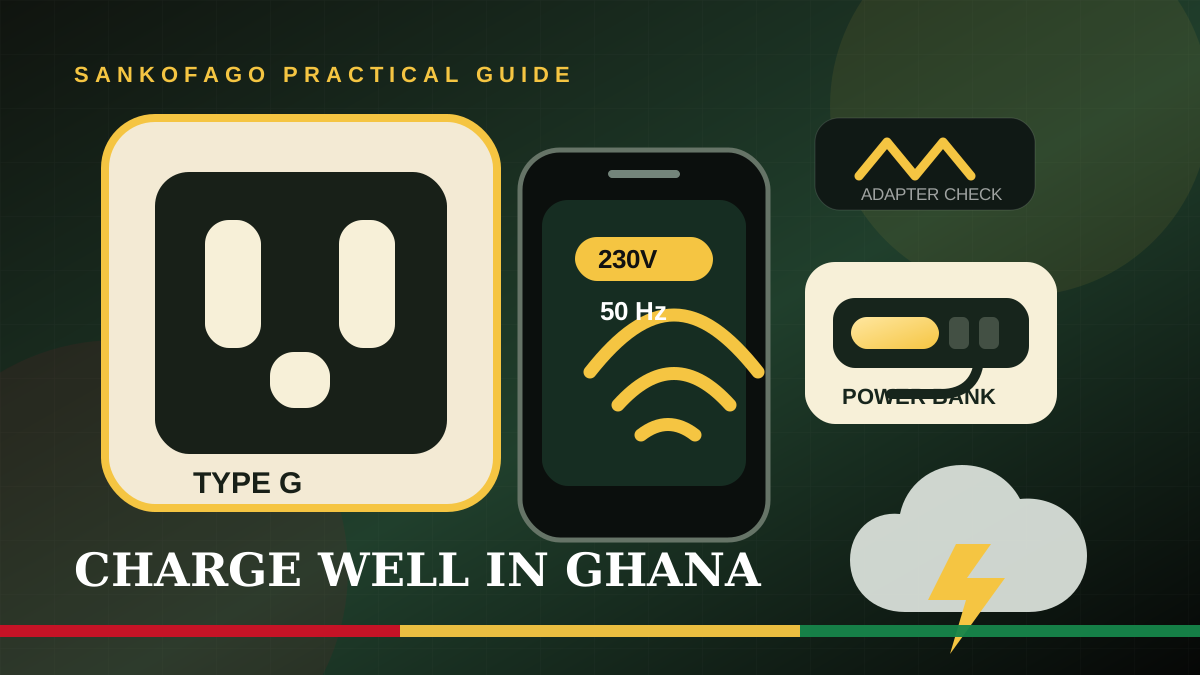
The short answer: bring the adapter before the converter
For most U.S., Canadian, and European travelers, the first Ghana electricity question is not "Will my phone work?" It is "Do I have the right plug shape, and can my charger accept 230V?" Modern phone, laptop, tablet, camera, and USB-C chargers usually list a wide input such as 100-240V on the charger brick. If yours says that, you normally need an adapter, not a voltage converter.
This guide is different from SankofaGo's Ghana packing list, SIM and eSIM guide, airport departure guide, travel health guide, accessible travel guide, and prescription medicine guide. The search intent here is narrower: how should you keep devices charged safely and reliably in Ghana without overpacking or making risky airport, hotel, or road-day assumptions?
- Best fit: first-time Ghana travelers, digital nomads, photographers, families, elders, medical-device users, wedding guests, content creators, and anyone planning long drives or regional stays.
- Pack first: a Type G adapter, a short extension strip if your lodging allows it, USB-C and Lightning cables, a labeled airline-compliant power bank, and a small pouch for chargers and spare batteries.
- Check before travel: charger voltage labels, power-bank watt-hour rating, airline rules, hotel outlet access, CPAP or medical-device requirements, and whether your itinerary has long road or rural nights.
- Do not assume: every hotel room has enough outlets, every universal socket grips safely, power banks can go in checked bags, or high-heat hair tools will work safely without voltage compatibility.
What plug type does Ghana use?
WorldStandards lists Ghana's official standard as Type G, the three-rectangular-pin plug also used in the United Kingdom, with 230V electricity and 50Hz frequency. A United Nations Ghana logistics note similarly tells visitors that Ghana uses 230V and 50Hz and says travelers whose devices use different plugs need an adapter.
Some Ghana visitor notes also mention Type D or two-round-pin sockets, and many hotels or apartments may have universal sockets. Treat that as a reason to pack flexibly, not as permission to arrive with no adapter. A grounded Type G adapter is the safest baseline for most travelers.
If you are coming from the United States, a simple plug adapter changes the shape of the plug; it does not lower Ghana's voltage. The converter question only matters when your device is not rated for 220-240V input.
Adapter, converter, transformer: what you actually need
A plug adapter lets your charger fit the wall. A voltage converter changes voltage for certain lower-wattage devices. A transformer is heavier and is usually relevant only for specific equipment that must run at a different voltage for longer periods. Most travelers should not buy a bulky transformer unless a device manufacturer or clinician tells them to.
Read the tiny print on each charger. If it says "Input: 100-240V, 50/60Hz," it is built for Ghana's voltage range. If it says only 110V or 120V, do not plug it directly into a Ghana wall outlet. That warning matters most for older hair dryers, curling irons, shavers, nebulizers, specialty chargers, and small appliances.
Heat tools deserve special caution. Even when a converter works on paper, high-wattage devices can overload cheap converters, trip breakers, or create heat risk. For Ghana trips built around weddings, funerals, naming ceremonies, or formal photography, it is often smarter to book local salon or barber time than to carry risky styling equipment.
Power banks and airport rules
Power banks are useful in Ghana because road days, beach days, markets, festivals, airports, and rural stops may not give you easy charging time. Pack them for the plane correctly. Ghana Airports Company Limited reminds passengers that lithium batteries or items containing lithium batteries must be declared during check-in when required, and IATA guidance says power banks and spare lithium batteries should travel in hand baggage, not checked baggage.
IATA's traveler guidance says batteries up to 100 watt-hours are generally allowed in carry-on baggage, batteries from 100 to 160 watt-hours may need airline approval, and batteries over 160 watt-hours are usually not permitted on passenger aircraft. It also says loose batteries and power banks should be protected from short circuits.
The practical traveler version: choose clearly labeled power banks, keep them in your carry-on, do not pack loose spare batteries in checked luggage, tape or cover exposed battery terminals, and check your airline if you carry drones, camera rigs, medical devices, smart luggage, or large power stations.
Outages, storms, and hotel charging reality
Ghana has a regulated electricity sector, with the Energy Commission responsible for regulatory and supervisory frameworks around electricity and related energy matters. That does not mean every traveler will experience power the same way. Neighborhood, weather, lodging quality, and regional route choices all affect the charging experience.
Electricity Company of Ghana says rainstorms and stormy winds can bring down trees, billboards, roofing, and other objects onto electrical conductors, causing outages. ECG also warns people not to go near sagging or fallen electrical conductors during rainy conditions.
For travelers, the safe planning rule is simple: charge before long transfers, do not let every device drop below 20 percent at night, ask hotels whether rooms have backup power, and never touch or step near fallen wires. If power is out, let your host, hotel desk, driver, or property manager handle local reporting.
Road days, rural stays, and group travel
Charging is easy to forget until everyone in the car wants the same USB port. On Accra-to-Cape Coast days, Kumasi routes, Volta Region loops, northern Ghana chapters, Western Region beach stays, family hometown visits, or festival weekends, build charging into the day the same way you build restrooms, water, food, and daylight driving into the day.
For a group, assign charging responsibility before the trip: one shared extension strip if allowed, one backup wall adapter, one car charger, one power bank per household or couple, and one charging pouch for documents and essentials. Families should charge phones before children use them for video or games on long drives.
Mid-article planning note: start at /plan and ask Nana for a "Ghana charging and road-day checklist." Share your route, lodging style, device list, medical-device needs, photographer or drone gear, group size, and whether you will be in Accra only or moving through Cape Coast, Kumasi, Volta, the Western Region, or northern Ghana.
Medical devices, CPAP, and accessibility planning
If you use CPAP, hearing aids, glucose monitors, mobility equipment, nebulizers, rechargeable medical devices, or battery-powered accessibility tools, do not treat power as a last-minute packing detail. Confirm voltage compatibility, plug type, battery backup, airline rules, hotel outlet location, and what happens during an outage.
Medical-device travelers should bring manufacturer documentation, enough charging cables, a labeled carry-on battery setup that complies with airline rules, and a hotel question list. Ask whether the bed has a reachable outlet, whether the property has backup power, whether staff can provide an extension cord safely, and whether outages are common in that area or season.
SankofaGo cannot give medical advice or guarantee utility service, but we can help turn power needs into itinerary requirements: fewer one-night stays, hotels with better backup planning, daylight transfers, driver charging options, and less risky rural pacing when a device must be reliable overnight.
What to pack for Ghana device charging
A simple Ghana charging kit should feel boring and dependable: Type G adapter, USB wall charger, USB-C cable, backup cable, car charger, power bank under airline limits, small cable pouch, and a short extension strip only if it is safe, fused where appropriate, and accepted by your lodging. Do not overload one outlet with every device in the room.
Photographers and creators should add labeled camera batteries, memory cards, dust protection, a laptop charger that clearly supports 100-240V, and a hand-baggage plan for lithium batteries. Drone users also need to check Ghana drone rules separately before packing equipment.
When you are ready to turn the checklist into a real itinerary, compare support levels at /pricing, then use /plan with "charging needs" in your notes. Tell Nana what devices matter most, where you are sleeping, how many long road days you have, and whether any medical or creator gear changes the route design.
Frequently asked questions
What plug adapter do I need for Ghana?
Pack a Type G adapter first. Ghana is commonly listed as using the UK-style three-rectangular-pin Type G plug, though some traveler notes also mention Type D or universal sockets in certain places.
What voltage does Ghana use?
Ghana uses 230V electricity at 50Hz. If your charger says 100-240V and 50/60Hz, you normally need only a plug adapter. If it says only 110V or 120V, do not plug it directly into a Ghana outlet.
Do I need a voltage converter in Ghana?
Usually not for modern phones, laptops, tablets, cameras, and USB chargers because many are dual-voltage. You may need a converter or different device for single-voltage hair tools, small appliances, or specialty equipment.
Can I bring a power bank to Ghana?
Yes, but carry it in hand baggage and check the watt-hour rating. IATA says power banks up to 100Wh are generally allowed in carry-on baggage, larger 100-160Wh batteries may need airline approval, and over 160Wh is usually not permitted on passenger aircraft.
Can power banks go in checked luggage?
No. IATA guidance says spare lithium batteries and power banks should be in hand baggage, not checked baggage, and should be protected from short circuits.
Are power outages common enough to plan around?
You should plan for the possibility. ECG says storms and fallen objects can cause outages, so travelers should charge before long transfers, ask hotels about backup power, and avoid fallen or sagging electrical conductors.
Can SankofaGo help with medical-device charging needs?
Yes. SankofaGo can build power needs into lodging, road timing, driver-charging, and pacing decisions, while you confirm medical and airline requirements with your clinician, device maker, and airline.
Sources & further reading
- WorldStandards - Ghana power plugs, socket and mains voltage
- United Nations logistics note - Ghana electricity information
- Energy Commission Ghana - mandate and functions
- Electricity Company of Ghana - outages, storms and customer information
- Ghana Airports Company Limited - passenger travel tips
- IATA - Safe Travel with Lithium Batteries
Ready to see it for yourself?
Plan your Ghana trip free with Nana, our AI planner — then our team books every car, hotel, and guide. You just confirm, pay, and go.
Start planning — it's free